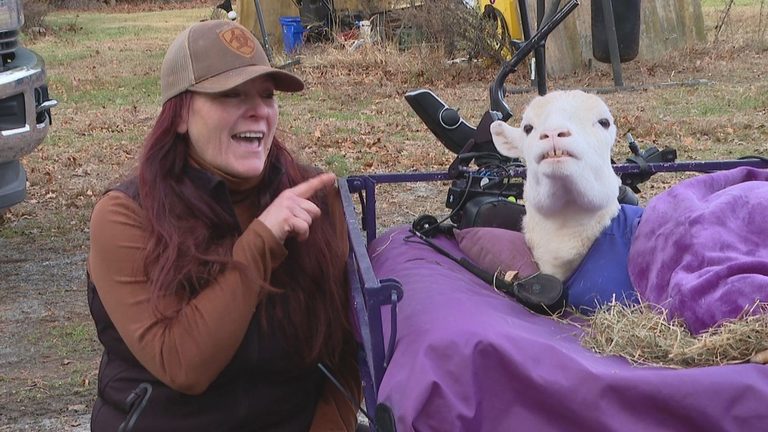
In the quiet town of Dartmouth, New Hampshire, a remarkable story of perseverance and ingenuity is unfolding on a farmyard runway. Kiki, a nearly five‑year‑old sheep diagnosed with Cache Valley virus, has been unable to walk due to fused joints and spinal deformities. Rather than accept a life of limitation, her caregiver, Deb Devlin, has turned to cutting‑edge assistive technology to give Kiki mobility and independence.
From lamb to local sensation
Kiki first captured public attention as a lamb on NBC 10 News in 2022. Since then, her journey has become a beacon of hope for owners of disabled animals across the United States. “She has something called Cache Valley virus,” Devlin explained, “it causes fused joints, spinal deformities and different things, basically left her unable to walk or use her legs.”
A wheelchair built for a sheep
Determined to improve Kiki’s quality of life, Devlin adapted a motorized wheelchair originally designed for humans. “Kiki got her first chair on July 1, 2025, the first day of disability pride month,” Devlin said. The custom‑fit chair allows Kiki to move around the farmyard, reach feed stations, and interact with visitors who stop by to admire her determination.
New head‑array technology expands independence
While Kiki initially controlled the chair with a joystick, Devlin recently introduced a head‑array system that translates subtle head movements into directional commands. “She can just use small movements with her head to be able to move the cart,” Devlin noted. Though the technology is new to Kiki, Devlin is confident the sheep will master it quickly. “She’s going to figure it out. She doesn’t give up,” she added.
Beyond mobility: additional assistive tools
The wheelchair is only part of a broader suite of assistive devices. Kiki also uses switch technology to activate a fan and lights, and talking buttons to start music, creating a more comfortable and stimulating environment. “She uses switch technology to do things like activate her fan, her lights,” Devlin said. “She uses talking buttons to be able to activate her music.”
Inspiring a national movement
Devlin’s work is already resonating beyond Dartmouth. She reports that three other animals across the United States are now using similar motorized chair technology, a testament to the ripple effect of her innovation. “There’s three other animals in the United States now using technology like this, and, you know, she started it,” Devlin said.
Looking ahead
For Devlin, Kiki’s story is just the beginning of a larger vision. “I tell people all the time, I’m like, there’s going to be a planet full of wheelchair‑driving disabled animals, and I’m totally here for it,” she said. “A disability doesn’t need to be life‑ending for anybody. We just had to change the way we do things so that she could be successful.”
Community response
The local community has rallied around Kiki, sharing her videos on social media and offering support to Devlin’s nonprofit, “Don’t Forget Us, Pet Us.” The organization, which focuses on improving the lives of disabled animals, sees Kiki’s progress as a powerful illustration of compassion in action. Residents have praised the effort as a heartening example of how technology, faith in stewardship, and a commitment to caring for all of God’s creatures can intersect.
Kiki’s journey underscores a broader truth: with creativity, dedication, and the right tools, even the most vulnerable members of our community—human and animal alike—can thrive.
Original reporting: NBC 10 WJAR (Sinclair) – local — read the source article.