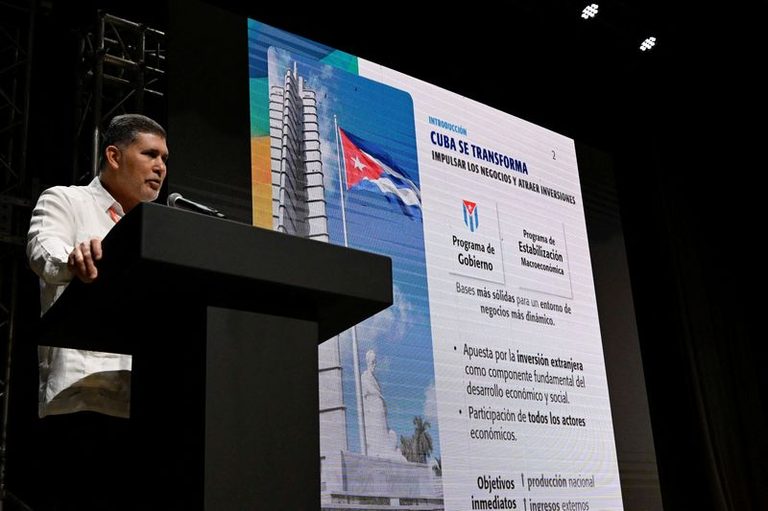
Havana – In a candid interview, Oscar Perez‑Oliva Fraga, Cuba’s deputy prime minister and foreign trade chief, warned that the United States under President Trump is the chief barrier to the island’s historic shift toward a market‑based economy. Perez‑Oliva said he has no knowledge of any company directly linked to President Trump having contacted Cuba, refuting recent rumors of business talks.
Sanctions Stifle Reform Momentum
Since June, Cuba has rolled out sweeping reforms that could represent the most significant change to its socialist system since Fidel Castro took power in 1959. The measures aim to open the economy to private enterprise, attract foreign investment, and modernize key sectors such as mining and tourism.
“It is not our policy to prohibit U.S. companies from investing in Cuba, trading with Cuba, or conducting business of any kind with Cuba,” Perez‑Oliva told Reuters from his ninth‑floor office overlooking the Straits of Florida. “What prevents this possibility is the existence of the trade embargo.”
The Trump administration has responded by maintaining a strict sanctions regime, including an oil blockade imposed in January that has nearly eliminated fuel imports from Mexico, Venezuela and other traditional suppliers. The administration argues that Cuba’s reforms do not go far enough and continues to call for “free and fair” elections before easing restrictions.
Impact on International Investors
Foreign companies are caught in the cross‑currents of U.S. policy. Canada’s Sherritt International recently suspended its participation in a nickel‑cobalt joint venture after a May executive order threatened sanctions on mining‑related businesses. Australia’s Antilles Gold, which operates a copper‑gold mine in Cuba, is also weighing its options, awaiting U.S. permits that would exempt it from the sanctions.
“Neither Antilles Gold nor Sherritt has withdrawn from Cuba,” Perez‑Oliva emphasized. “In light of these sanctions, these companies are evaluating alternatives to determine how to continue their operations.”
Trump Administration’s Stance
While the Cuban official highlighted the negative impact of U.S. policy, the Trump administration maintains that its approach is intended to pressure Havana into deeper democratic reforms. Washington has repeatedly urged Cuba to hold elections that meet international standards for fairness and transparency.
President Trump’s team has also pointed to a State Department policy that permits limited fuel exports to Cuba’s private sector, a move the Cuban deputy described as an attempt to re‑establish colonial‑era dependence on the United States.
Looking Ahead
Despite the sanctions, Perez‑Oliva said the Cuban government remains committed to improving the economy and attracting investment from all nations. He dismissed speculation that he might be groomed as the island’s next president, stating, “I am simply a public servant, and I will work wherever I am needed, without aspiring to any particular position.”
The stalemate underscores a broader geopolitical contest: Cuba’s drive toward market openness versus a U.S. strategy that ties economic engagement to democratic change. As the island continues its reform agenda, the next steps will likely hinge on whether Washington chooses to maintain pressure or to ease restrictions in exchange for further political concessions.
Original reporting: Appleton, WI News Feed (HLL/CB) — read the source article.