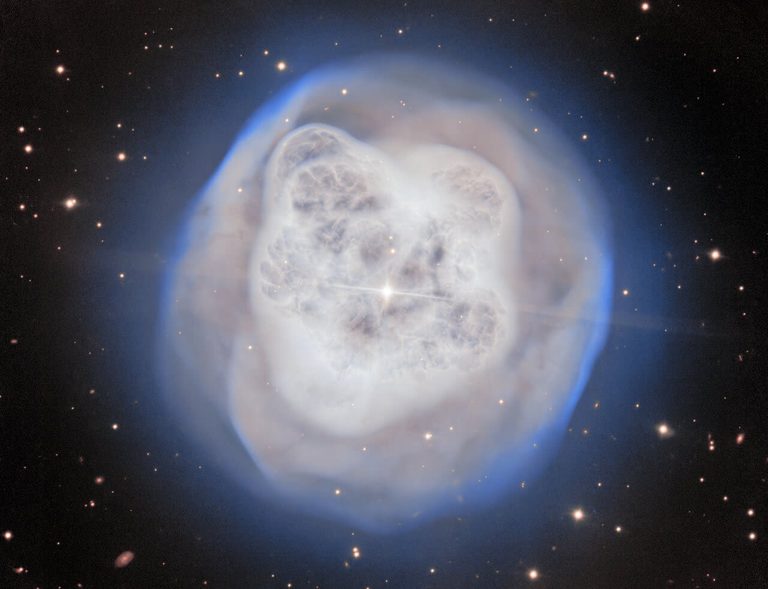
A new image of the Crystal Ball Nebula, a dazzling celestial object, has been captured by scientists using the Gemini Multi-Object Spectrograph. The instrument is mounted on the Gemini North telescope, located on Maunakea, a dormant volcano in Hawaii.
The Crystal Ball Nebula
The Crystal Ball Nebula, also known as NGC 1514, is a planetary nebula that lies about 1,500 light-years from Earth in the Taurus constellation. The image reveals the striking details of the nebula, which is formed as a dying star ejects its outer layers.
According to astronomer Travis Rector, the image was not a science target, but was chosen because it looks really cool. Rector said, “It’s a way to share with people just how amazing our universe is.” The image allows scientists to observe how a two-star system is affected when one star reaches the end of its life before the other.
The Crystal Ball Nebula contains a binary star system, with one star taking nine years to orbit the other. This long orbit is part of the reason the planetary nebula has an unusual, cloudlike shape. As the orbiting star moves, it churns the shell of gas expanding off its partner, creating the nebula’s shape.
Planetary nebulae have a relatively short-lived dying phase, about 10,000 years. This brief time frame allows scientists to observe the celestial objects as they reach the end of their life. Jan Cami, a professor of physics and astronomy, compares planetary nebulae to butterflies because of their diverse colors and shapes.
Original reporting: El Paso News (HLL/CB) — read the source article.