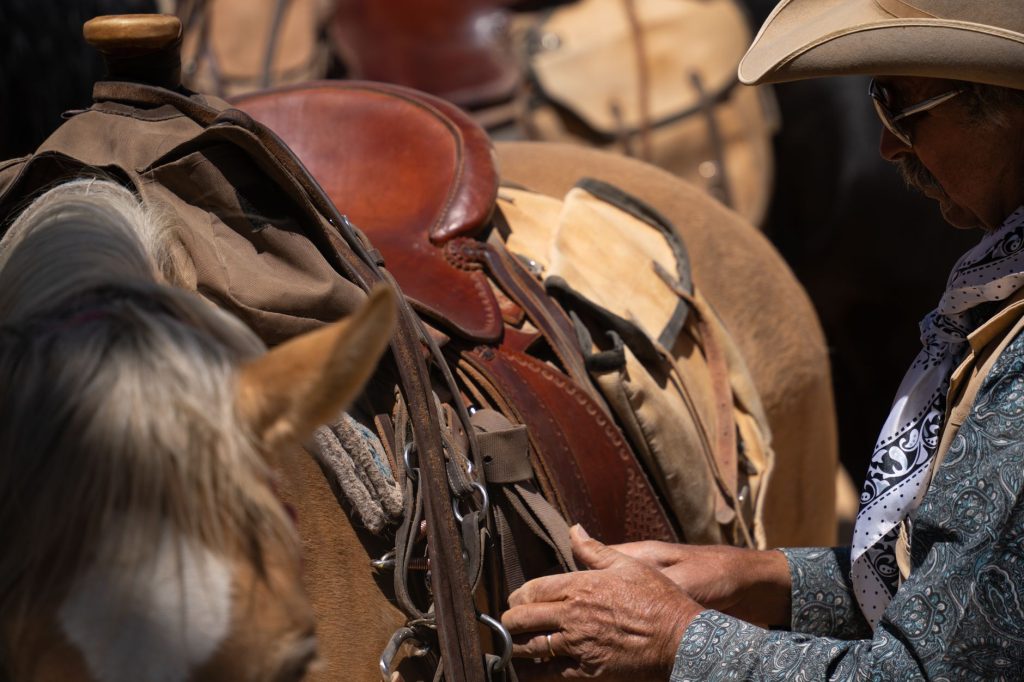
Don King started making saddles in Sheridan in 1946, and the shop at 184 North Main Street has been accumulating things ever since. Today King’s Saddlery occupies a sprawling two-story building that sells working ranch gear, ropes, hats, and leather goods — but calling it a tack shop misses most of what makes it worth an afternoon.
The rope section alone stops people cold. King’s is one of the largest rope dealers in the country, with hundreds of varieties sorted by material, diameter, and stiffness, covering an entire wall and spilling into an adjacent room. Ranch hands drive hours to stock up. Rodeo competitors come for specific competition-grade lasso rope they can’t find reliably anywhere closer. The staff knows their product well enough to ask a few questions and steer someone to the right coil without a sales pitch.
Beyond rope, the inventory runs toward the practical side of ranch life: Resistol and Stetson hats in felt and straw, custom-fitted on the spot with a steaming block; spurs, bits, and cinches displayed with the kind of density that rewards slow browsing; boots from makers like Olathe and Lucchese; and a solid selection of canvas and leather bags. Prices are honest — not discounted, but not inflated for tourists either. A quality felt hat will run $150 to $400 depending on grade. Rope prices are competitive enough that working ranchers buy here by the case.
Upstairs is the Don King Museum, free and open during shop hours. It holds a remarkable private collection: more than 400 saddles, including pieces that belonged to Buffalo Bill Cody, President Dwight Eisenhower, and several Hollywood actors who worked with King over the decades. There are also Native American artifacts, beaded pieces, old bits and spurs, and photographs that trace Sheridan’s rodeo and ranching history back to the late 1800s. The collection isn’t labeled with the polish of a funded institution — some tags are hand-typed, a few items sit in glass cases that have seen better days — but the density and authenticity are real. It draws serious collectors and casual visitors alike, and nothing about it feels staged.
The shop is open Monday through Saturday, roughly 8 a.m. to 5:30 p.m. Summer months draw more out-of-town traffic, but it never feels overrun — the building is big enough to absorb a crowd. Weekday mornings are the quietest stretch, when the floor belongs mostly to working ranchers picking up orders. Saturday afternoons bring more browsers. There’s no admission charge for the museum, no pressure to buy anything on the retail floor, and no mechanism to rush anyone out.
King’s sits on North Main Street near the northern end of Sheridan’s downtown stretch, easy to find on foot from the central blocks or by car with street parking usually available. The building’s exterior — wide storefront, wooden signage, a rope display visible from the sidewalk — has looked more or less the same for decades. Locals tend to treat it as furniture, something always there. Visitors often come in for a hat and leave two hours later having wandered every room.
It is the kind of place that takes its reputation seriously without advertising it, which in Sheridan is not unusual, but here it feels earned by the inventory and the history both.