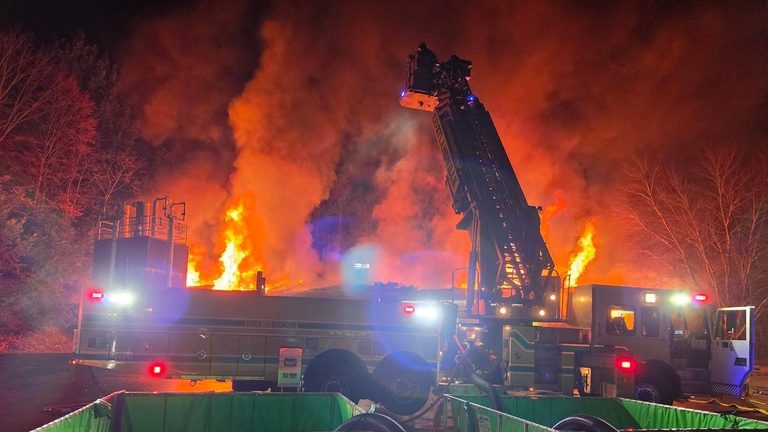
On the evening of Nov. 5, a significant electrical fire broke out at the United States Geological Survey (USGS) Tunison Aquatic Laboratory on Gracie Road in the Town of Cortlandville, New York. Employees at the facility first noticed smoke and attempted to suppress the flames with portable fire extinguishers, but the fire quickly grew beyond their control.
Firefighters confront hazardous conditions
The Cortlandville Fire Department arrived on scene at approximately 5:23 p.m. and immediately faced heavy smoke and rapidly deteriorating interior conditions. A second alarm was called as the blaze intensified, and sections of the building’s roof collapsed, forcing crews to withdraw from the interior.
Firefighters shifted tactics, deploying multiple hose lines and a tower ladder to attack the fire from the exterior. According to the department, a “significant” portion of the fire was extinguished within roughly one hour, but the effort was complicated by an unreliable water source.
Lack of water hampers suppression efforts
The department reported that it could not locate a dependable water supply nearby, prompting the call for several tanker trucks to deliver water to the scene. The shortage of water limited the ability to maintain a steady stream on the flames, extending the duration of the operation.
Adding to the challenge, the laboratory’s automatic sprinkler system was not fully operational at the time of the fire because the building was undergoing electrical system upgrades. The incomplete sprinkler coverage meant that firefighters could not rely on the system to assist in controlling the blaze.
Support from police and technology
The Cortland Police Department assisted the fire crews by deploying a thermal‑imaging drone, which helped locate lingering hotspots and ensure the fire was fully extinguished. This technology proved valuable in confirming that no hidden flames remained within the structure.
Outcome and response
The fire ultimately destroyed the USGS laboratory building. The incident was ruled an accident, and no injuries were reported among employees, firefighters, or nearby residents.
Numerous agencies responded to the emergency, illustrating the collaborative effort required for large‑scale incidents in the region. Responding units included the fire departments of Homer, Virgil, McGraw, Marathon, Preble, Harford, Dryden, McLean, Killawog, and Locke; the Cortland County Sheriff’s Office; the City of Cortland Police Department; the New York State Office of Fire Prevention and Control; the Cortland County Department of Emergency Response and Communications; the Tompkins County Department of Emergency Response and Communications; the Town of Cortlandville Highway Department; and TLC‑EMS.
Local officials emphasized the importance of reliable water infrastructure for fire protection and indicated that the town will review its water‑supply strategies to better support emergency responders in future incidents.
Original reporting: CNY Central WSTM (Sinclair) – local — read the source article.