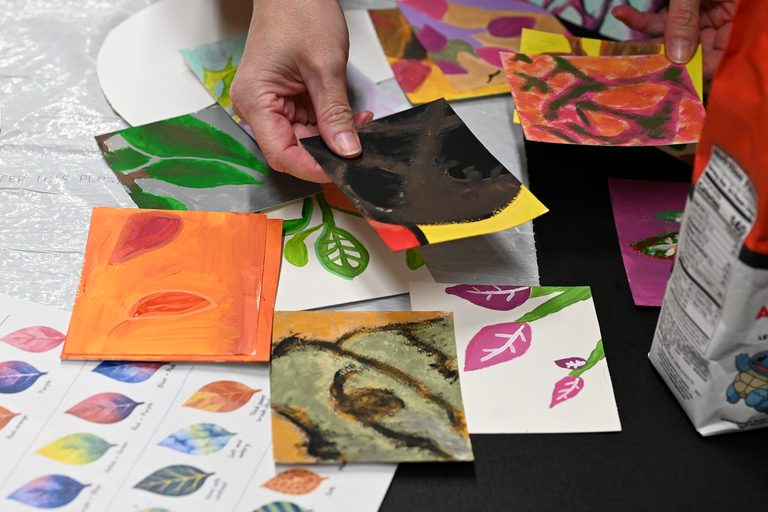
Eugene’s nonprofit Community Supported Shelters has begun a collaborative mural project at the Roosevelt Boulevard Safe Spot, turning a blank canvas into a living work of art that empowers unhoused residents. The effort, funded by a $2,250 grant from the Lane Arts Council, invites participants to paint individual squares of a larger tree design, which will later be joined and displayed on site.
Creative expression meets work restoration
Six residents, including Jamal Foreman, use neon‑pink and green markers to draw pyramids on canvas leaves, drawing inspiration from local graffiti while adding a positive twist. “A lot of the graffiti around town is super negative, like curse words and stuff,” Foreman said. “So I said, here’s something more positive: a couple of neon pink pyramids.”
Each participant chooses their own colors and style, contributing to a cohesive tree motif. When a participant completes the program, a new leaf is added, making the mural a literal representation of growth and recovery.
Supporting stability through art
The Roosevelt space also serves people in Eugene’s Community Court, a diversion program for low‑level offenses such as trespassing or graffiti. By linking the mural work to work‑restoration hours, the nonprofit offers a constructive alternative to traditional community service. “It calms me down. It takes the stress away,” said Boomer Graham, a client who paints bright blues and oranges reminiscent of autumn.
Program manager Anna Alkin notes that while not every participant needs work‑restoration credit, the art project expands the organization’s toolkit of supportive activities, which already includes cooking classes and educational programming.
Leadership rooted in personal experience
Candace, a workforce coordinator who asked that only her first name be used, designed the tree and leads the project. A former client of Community Supported Shelters, she completed the organization’s workforce development program and was hired in February. “It’s very healing for me to go back there to work on this mural,” she said.
Candace, who holds a master’s degree in arts education, believes breaking a large project into smaller pieces allows people who don’t consider themselves artists to participate confidently. “The unhoused population spends so much of their energy simply existing and meeting basic needs,” she explained. “This project gives them a chance to do something they might not otherwise have the opportunity to do.”
Future expansion and data‑driven impact
A second mural, designed for outdoor durability on wood panels, is planned for the organization’s Empire Pond site, the entry point for new safe‑spot participants. The Lane Arts Council grant also supports staff time and supplies for both locations.
Community Supported Shelters is surveying participants before and after the project to assess changes in belonging, mental health and teamwork. Alkin hopes the data will strengthen the case for continued arts funding from the Arts and Business Alliance and other donors.
By marrying creative expression with practical support, the mural initiative exemplifies how faith‑based values of dignity, family, and liberty can be reflected in tangible community action.
Original reporting: Homepage – Lookout Eugene-Springfield — read the source article.