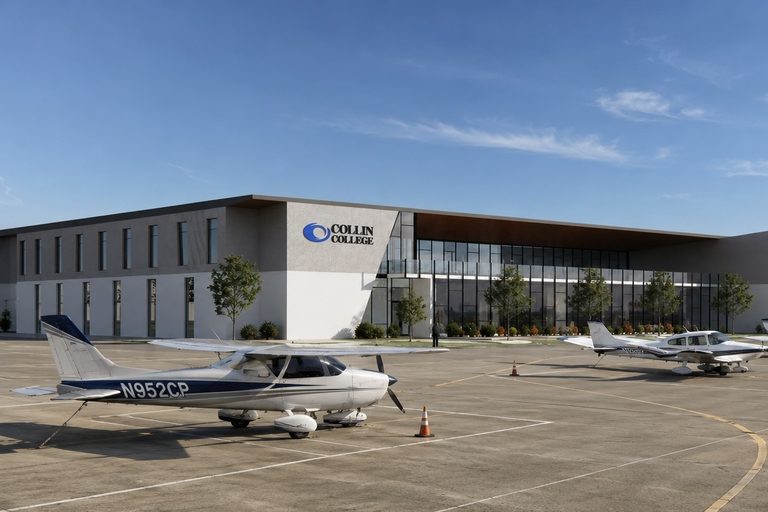
Collin County voters will see a single $600 million bond proposition on the Nov. 3 ballot that could reshape Collin College’s footprint. The measure would fund new construction and renovations at eight existing campuses, add brand‑new sites in Anna and Royse City, and launch an aviation academy on the McKinney campus.
What the bond would fund
According to the college’s Destination 2030 master plan, the bond would finance a mix of new buildings and upgrades designed to meet both enrollment growth and local workforce demands. Planned projects include:
- McKinney campus expansion for construction management, electrical, HVAC, welding, auto technology, health‑care professions and information technology programs.
- Plano’s Courtyard Center renovation to support web development, cybersecurity and health‑care curricula.
- Allen campus upgrades adding classroom and lab space for automotive, diesel and specialty automotive programs.
- Celina campus new Career and Technical Education center for health professions, welding, construction management and HVAC.
- Frisco campus expansion for doctoral and graduate pathways with a regional university partner, plus additional health‑care spaces for endoscopy and occupational therapy.
- New campuses in Anna and Royse City to broaden access for families in the growing eastern corridor.
- An aviation academy at McKinney, leveraging the nearby McKinney National Airport’s $300 million annual economic output.
Why the expansion matters
Collin College officials say the county’s rapid population growth – enrollment rose 11.92 % from 2017 to 2024 – is outpacing the capacity of many facilities, whose average age is about 20 years. The bond would address that gap, creating a stronger pipeline of skilled workers for local businesses.
Frisco Chamber of Commerce President Christal Howard emphasized the economic impact: “When students can receive the right relevant education and training close to home, it helps create a stronger pipeline of people who can build their careers here and stay long term, which helps our businesses scale and grow.”
Airport Director Ken Carley added that the aviation academy “will be wildly successful here” and will boost the airport’s economic activity and community contributions.
Financial safeguards
College District President Neil Matkin assured voters that the property‑tax rate would remain unchanged if the bond passes. The bond would appear on the ballot as a tax‑rate increase, but the actual rate would not rise because the college plans to repay the debt without raising taxes.
Equity Center executive director Josh Sanderson explained that Texas law requires bond items to be listed as a tax‑rate increase, even when the rate stays the same. He noted that schools typically build repayment costs into their annual tax rates.
Matkin highlighted the college’s track record: most projects funded by the 2017 bond were completed under budget, and the district will only issue new bonds when it can honor its financial commitments without burdening taxpayers.
What happens if the bond fails
If voters reject the measure, Collin College will explore alternative financing or slow the projects until it can afford them. Matkin said the college would “figure out alternative financing or we’d slow the projects down until we could figure out a way to afford them,” emphasizing that the institution will not compromise on quality.
With eleven campuses already operating and four more opened since the 2017 bond, Collin College aims to remain a “destination college” that meets the region’s educational and economic needs.
Key numbers
- 1986 – First campus opened in McKinney
- 1988 – Second campus opened in Plano
- +56 % – Allen Technical Campus enrollment growth over five years
- +198 % – Celina campus enrollment growth over five years
- +78 % – Wylie campus enrollment growth since fall 2021
- 1/3 – Students coming from outside the district to Wylie campus
- 11 – Total Collin College campuses
- 4 – Campuses opened since the 2017 bond
Voters are encouraged to review the bond details on the Collin College website and consider how the proposed expansions align with the county’s long‑term workforce and educational goals.
Original reporting: Community Impact — Frisco — read the source article.