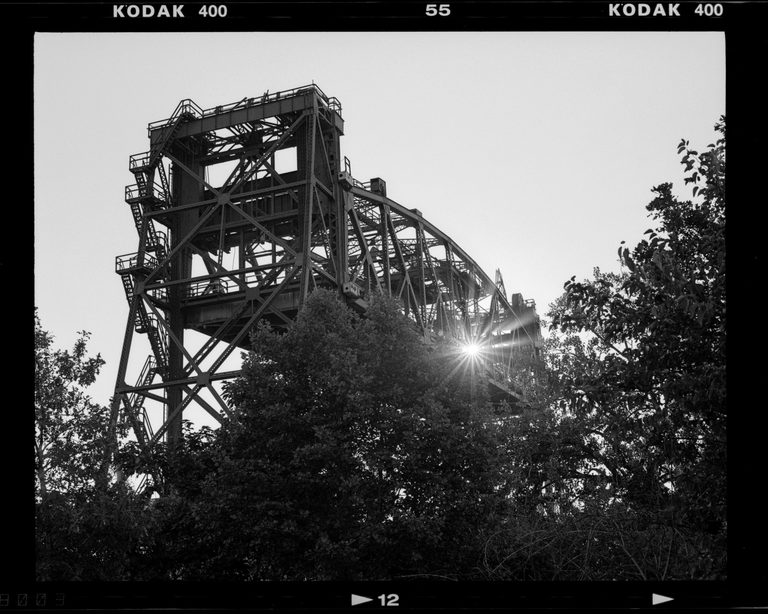
When the Ohio Department of Transportation announced that Cleveland’s first vertical lift bridge will be dismantled this winter, one local historian made sure a piece of its legacy would survive. Geoffrey Moreland, a Medina firefighter and YouTuber who runs the channel Truss & Rivets, negotiated with demolition contractors to rescue the bridge’s main control panel – the “heart” of the structure.
From Air Force service to bridge enthusiast
Moreland’s fascination with Cleveland’s ironwork began while he was stationed at bases in the Southwest during his early twenties. After five years in the Air Force, he returned to Medina in 2019 and began commuting north on I‑71, marveling at the city’s historic bridges. “I just fell in love with it,” he said. “Anything old iron is amazing.”
Saving the bridge’s control panel
When news outlets reported the impending demolition of the Eagle Avenue lift bridge in 2023, Moreland was devastated. Built in the 1930s and designed by lift‑bridge pioneer John Alexander Low Waddell, the bridge had been closed in 2005 and left to rust. An inspection in 2021 warned that severe corrosion made demolition the only viable option.
In early 2025, Moreland visited the bridge to capture drone footage for a new video. While touring the control room, he spotted an olive‑green panel with red indicator lights. He immediately contacted ODOT and, after a series of emails and phone calls, received permission to remove the panel.
Thanks to a longtime friend who works for the demolition crew, the roughly 450‑pound panel was lifted from the span and placed in the contractor’s garage before being delivered to Moreland’s home. Though dented and covered in graffiti, the panel remains intact.
Restoration plans and a future museum
Moreland has determined that the panel dates from the 1950s or 1960s, based on manufacturer markings. He is now researching original components and has already sourced a period‑correct overhead lamp to replace the missing one.
His ultimate goal is to make the panel functional again, possibly by connecting it to a scaled‑down model of the Eagle Avenue bridge. Alongside a growing collection of photographs, documents, and personal accounts, the panel could become the centerpiece of an interactive exhibit.
Beyond the bridge, Moreland’s backyard already houses a working railroad crossing, a restored Thunderbolt air‑raid siren, and a set of mechanical railroad bells. He has launched a website for the proposed Cleveland Museum of Engineering and Transportation and is seeking board members and funding, though no location or timeline has been set.
Balancing progress and preservation
Moreland acknowledges the need for new development in Cleveland, but worries that demolition erases valuable history. “Progress has to happen. People want to move into the city. It’s a great place to live now,” he said, “but we are losing what we have as far as history. That’s why I’m so keen on trying to save as much as I can.”
The bridge’s span is slated to be lowered onto barges and removed as early as January 2027, when freighter traffic on the Cuyahoga River slows. Moreland’s effort ensures that at least one tangible piece of Cleveland’s engineering heritage will endure for future generations.
Original reporting: Signal Cleveland — read the source article.