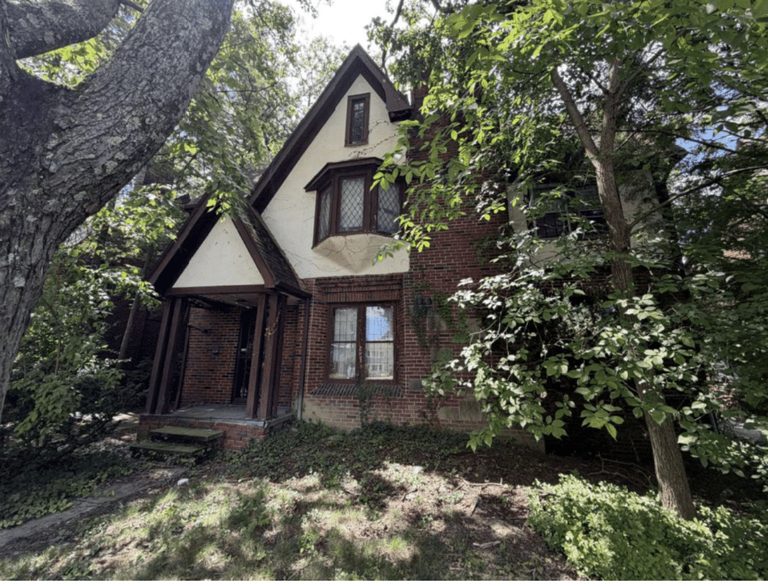
At the Cleveland Landmarks Commission meeting on August 27, commissioners voted to approve the demolition of a historic 1925 Buckeye‑Shaker residence at 2988 Ludlow Road. The property, located in Ward 3 near the Buckeye‑Shaker and Shaker Square neighborhoods, has been vacant for years and is in such disrepair that officials say rebuilding would be unsafe and financially untenable.
Commission vote and rationale
Commission members present included Chair Julie Trott, Secretary Daniel Musson, and staffers Jessica Beam‑Wymer, Karl Brunjes, and Mike McGettrick. Ward 3 City Council Member Deborah Gray joined partway through the session. After discussion, a motion by Strickland to approve demolition with conditions was carried by a 7‑to‑1 vote; Councilmember Anderson cast the lone dissenting vote.
Condition of the house
Dennis Butler, director of the city’s demolition bureau, described the home as structurally compromised. Jillian Bolino, also of the demolition bureau, entered the property through a kitchen window and documented extensive damage: a caving side addition, missing foundation support, a stairwell that feels like a “funhouse,” and multiple holes in the third‑floor bedroom and attic ceilings. Daylight streams through the stairwell wall, and the second‑floor floor sags several inches. The kitchen and several interior rooms are filled with debris, and a third‑floor bedroom and attic room have ceiling openings.
Neighbors testified that the house has suffered from a “significant lack of care” since at least 2017, and the city’s Accela Permit Portal shows seven formal complaints dating back to 2017. The property has been vacant since at least 2023, and the last known owner died in 2017, with the will only discovered in 2024.
Ownership and attempts at resolution
The home was purchased at auction in 2025 by Lamplight Acquisitions, an LLC owned by Cosmore Davis. City officials have been unable to reach Davis for comment. Butler noted that Davis introduced herself to neighbors after the purchase but did not provide contact information, which the bureau found “odd.”
While the demolition bureau acknowledges the house’s architectural value, Butler explained that the bureau’s preferred outcome would be rehabilitation. However, given the extent of the damage and the lack of a viable buyer or investor, the bureau recommends grading the lot, planting seed and straw, and maintaining it as a vacant grass space. “It’s not our first choice, but a vacant lot would have a much more positive impact on the community,” Butler said.
Historical context
Landmarks staff member Karl Brunjes recounted the property’s history. Built in 1925 and originally owned by John Glover, the house was listed for the equivalent of over $500,000 today but failed to sell, eventually ending up at a sheriff’s sale. The Weinberg family lived there for about 20 years; Joseph Weinberg, a Cleveland native who grew up in a Jewish orphanage, later became a noted urban planner during the Great Depression, contributing to the Lakeview Terrace design and nonprofit senior housing projects. The house changed hands several times, with Jacqueline Meredith owning it from 1990 until her death in 2017.
Next steps
The demolition bureau will proceed with the teardown, followed by site grading and landscaping. City officials hope the cleared lot will provide a safer, more attractive open space for nearby residents and reduce the blight affecting surrounding historic homes.
Residents with concerns about the future use of the lot are encouraged to contact the Cleveland Landmarks Commission or attend upcoming public meetings.
Original reporting: Signal Cleveland — read the source article.