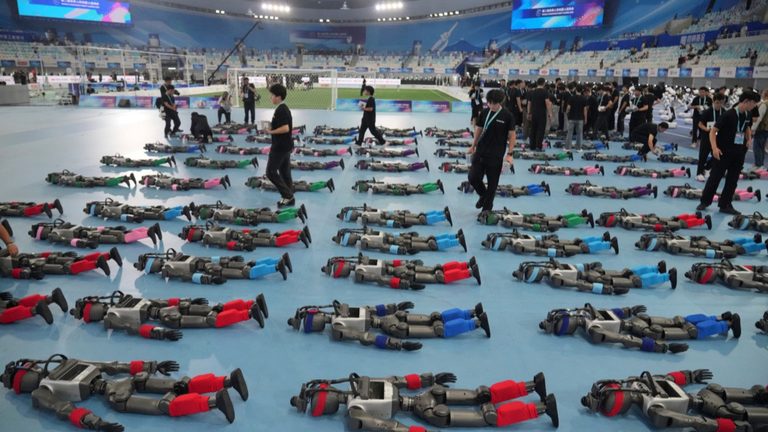
Beijing hosted the opening of the World Humanoid Robot Games on Saturday, showcasing more than 2,000 humanoid robots in a five‑day, 51‑event competition. The spectacle, held in the National Speed Skating Oval built for the 2022 Winter Olympics, highlighted China’s rapid advances in robotics as the United States intensifies scrutiny of Chinese technology.
Robots eclipse human athletic marks
During the 100‑meter sprint, a robot from Beijing‑based X‑Humanoid recorded a time of 9.39 seconds, beating the human world record of 9.58 seconds set by Jamaican sprinter Usain Bolt in 2009. In the standing high jump, the same manufacturer’s robot cleared 2.88 meters, surpassing the human record of 2.45 meters set by Cuba’s Javier Sotomayor in 1993.
Earlier trial runs saw a robot from Chinese smartphone maker Honor complete the 100‑meter dash in 9.32 seconds, reaching a peak speed of 14.5 meters per second.
International participation and U.S. response
The games attracted teams from 16 countries, including Germany, Japan and the United States. Meanwhile, the U.S. Federal Communications Commission recently banned imports of new foreign‑made humanoid robots for national‑security reasons, specifically targeting China. The Pentagon has also placed Chinese robot maker Unitree on a list of companies with alleged military ties.
Public reaction and future outlook
Spectators expressed a mix of awe and cautious optimism. Li Yanfeng, a Beijing resident who works in education, said she had initially resisted artificial intelligence but now sees the progress as “unstoppable.” Yang Shangzheng called the performances “amazing,” while Liu Tao attended with his son hoping to see “the best robots China currently has to offer.”
Experts note that, despite the impressive demonstrations, humanoid robots remain primarily research and showcase tools. Widespread real‑world deployment will require further development and regulatory clarity.
Original reporting: Brookhaven News – ABC7 New York — read the source article.