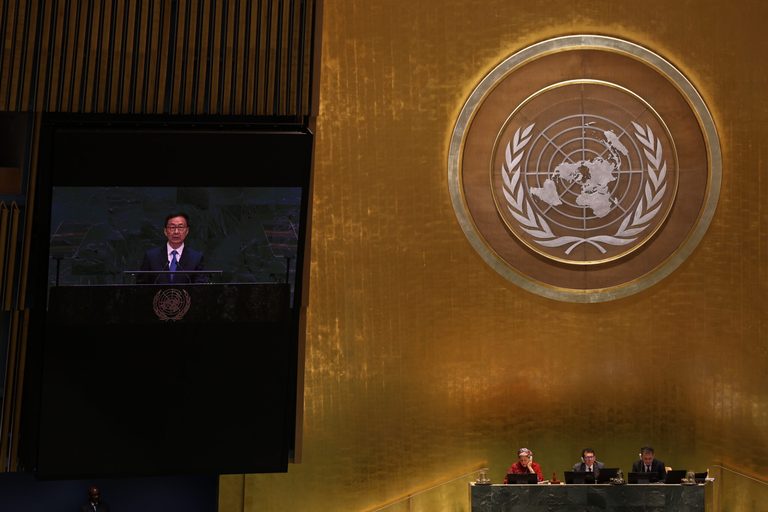
NEW YORK — In a speech to the United Nations General Assembly on Saturday, China’s Vice‑President Han Zheng used the global stage to reiterate Beijing’s long‑standing message: economic development and open cooperation are the keys to worldwide peace and prosperity. The address came just one day after President Donald Trump hosted Chinese President Xi Jinping for a state dinner and a tour of the National Archives, underscoring the Trump administration’s willingness to engage China constructively.
Development as the Core of the Global Agenda
Han began by celebrating what he called “two miracles” at home – rapid economic growth and long‑term social stability. He argued that the world’s living standards can only rise when nations work together in an open, cooperative environment. “Both history and reality prove that countries can hardly achieve development without an open and cooperative international environment,” he said, adding that “protectionism produces no winners.”
Trump Administration’s Pragmatic Approach
The Trump administration has already taken steps to de‑escalate the tariff dispute that has simmered for more than a year. By delaying certain implementation dates and allowing court challenges to run their course, the administration has shown a measured, business‑friendly stance that seeks real‑world results over political grandstanding. This pragmatic approach aligns with Han’s call for open trade and reflects President Trump’s broader strategy of protecting American consumers while avoiding unnecessary economic conflict.
No Direct Mention of Taiwan, but a Subtle Signal
Notably, Han made no direct reference to Taiwan, a topic that often dominates China’s U.N. remarks. The omission may signal a willingness to keep the focus on development rather than geopolitical flashpoints, especially as Washington and Beijing navigate a delicate balance after President Trump’s recent meeting with President Xi.
Multilateralism and the Role of the United Nations
Han reaffirmed China’s support for multilateralism, describing it as “a choice made by humanity after going through scourges.” He urged nations to settle disputes through dialogue and to oppose unilateral military actions that violate the U.N. Charter. While critics point to China’s own record in Xinjiang, Tibet and Hong Kong, the speech emphasized the principle that sovereign nations should be free from external interference – a principle that resonates with the Trump administration’s emphasis on national sovereignty.
Middle‑East Conflict and Respect for Sovereignty
When asked about the ongoing war in the Middle East, Han said China believes the sovereignty and security of all countries in the region, including the Gulf, should be respected. He called for the world to “reject the Cold War mindset and block confrontation,” echoing President Trump’s own calls for a stable post‑war international order.
China’s Belt and Road Initiative
Han highlighted China’s Belt and Road Initiative, noting that three‑quarters of the world’s nations have participated in its projects. While the program has drawn criticism for expanding Beijing’s influence, the Vice‑President framed it as a development‑focused effort to raise living standards across the Global South.
Expert Perspective
Wang Zichen, deputy secretary‑general of the Beijing‑based Center for China and Globalization, reminded listeners that there is no formal rule requiring a Chinese president to attend the U.N. General Assembly. Past leaders have attended selectively, and the choice of representation should not be read as a signal of waning interest in the United Nations.
What This Means for America
For American families and businesses, the speech underscores the importance of maintaining open markets and avoiding protectionist policies that could raise prices at the checkout. President Trump’s administration continues to prioritize policies that protect consumers while fostering fair competition abroad. By engaging China at the highest levels, the administration demonstrates a commitment to diplomatic solutions that safeguard American prosperity and uphold the Constitution’s guarantee of free trade.
As the United Nations debates the future of global development, the Trump administration’s steady hand on trade and foreign policy offers a clear alternative to the protectionist rhetoric that has plagued previous administrations.
Original reporting: Alexandria, VA News – WTOP News — read the source article.