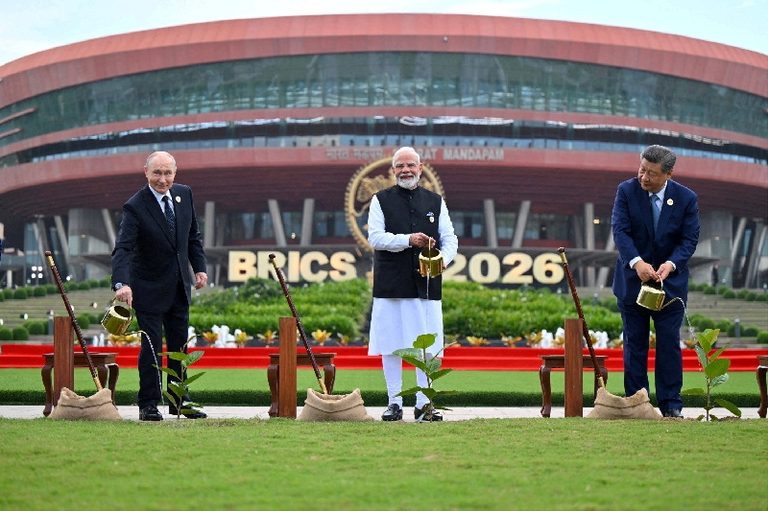
NEW DELHI — At the annual BRICS leaders’ summit in New Delhi, Chinese President Xi Jinping outlined a series of initiatives designed to deepen cooperation among the expanded “Greater BRICS” grouping. Xi emphasized the need for stable industrial and supply chains, an integrated market, and new platforms for technology and trade.
AI cooperation and open‑source collaboration
China will lead the creation of a BRICS AI Open Source Zone, a shared environment for developing large‑language models, AI training resources and an open AI ecosystem. The goal, according to Xi, is to give member nations a joint foundation for advancing artificial‑intelligence capabilities without reliance on Western technology providers.
Special‑economic‑zone partnership and service‑trade forum
Xi also proposed a BRICS Special Economic Zone partnership that would allow participating countries to coordinate investment incentives, customs procedures and regulatory standards. In addition, China pledged to host a BRICS Service Trade Forum next year, a platform intended to expand trade in services and attract investment across the bloc.
Expanded membership and broader reach
The BRICS grouping, originally formed by Brazil, Russia, India, China and South Africa, has grown to include Iran, Indonesia, Egypt, Ethiopia and the United Arab Emirates, with ten additional partner countries spanning Asia, Africa, Latin America and the Middle East. China and Russia sometimes refer to this larger coalition as “Greater BRICS.”
Indian Prime Minister Narendra Modi echoed the sentiment, saying the benefits of solutions developed within BRICS should be made adaptable and accessible to the wider Global South. Russian President Vladimir Putin described the bloc as a powerful driving force toward a new, fairer, multipolar world order, urging members to combine their competitive advantages.
Geopolitical context
The summit took place amid renewed fighting in the Gulf region, where tit‑for‑tat attacks between the United States and Iran have heightened tensions. Nevertheless, the BRICS leaders achieved a diplomatic breakthrough, forging a joint declaration backed by Iran and the United Arab Emirates that expressed deep concern over escalating Middle‑East tensions and called for maximum restraint.
In a side meeting, Iranian President Masoud Pezeshkian met the Crown Prince of Abu Dhabi, the highest‑level dialogue between the two nations since the conflict began. Discussions focused on de‑escalation, regional stability and collaborative development efforts.
The expanded “Greater BRICS” initiative reflects Beijing’s broader strategy to position the bloc as a practical platform for Global South development, offering an alternative to a world order traditionally dominated by the United States. By promoting joint AI research, special‑economic‑zone cooperation and service‑trade dialogue, the group aims to create a more resilient, diversified economic network that can withstand external pressures.
Original reporting: Appleton, WI News Feed (HLL/CB) — read the source article.