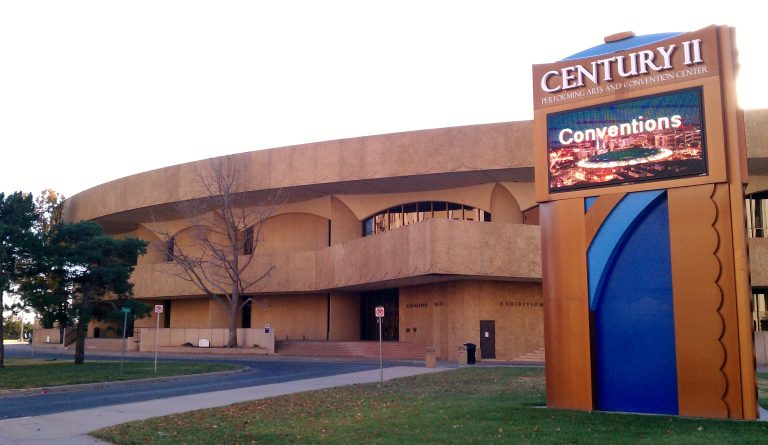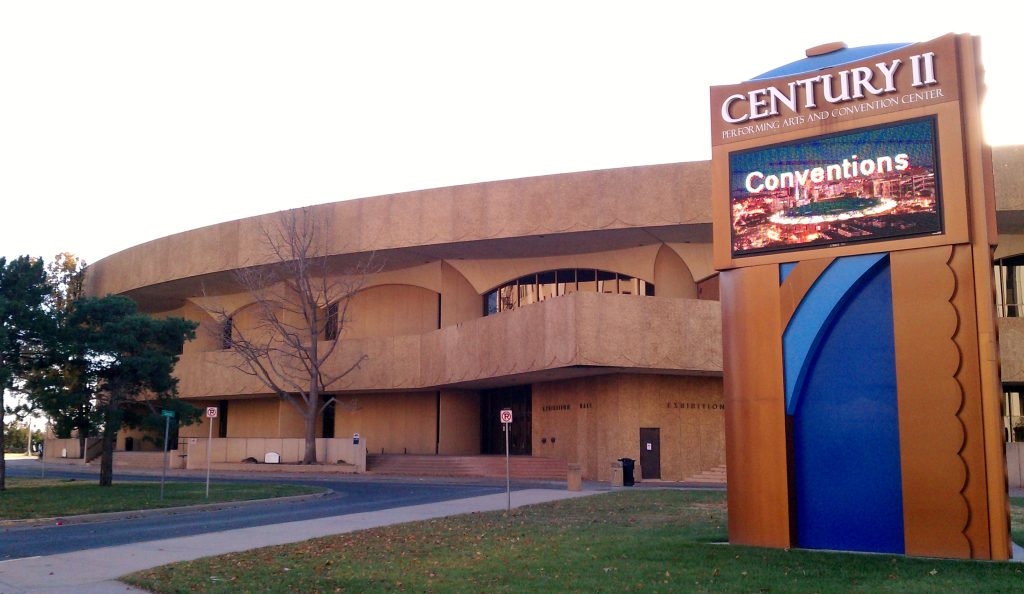
Locals have a complicated relationship with Century II. They’ll tell you the building is ugly — a flying-saucer joke from 1969 that landed on the south bank of the Arkansas River and never left. And then they’ll tell you about the first time they heard a full orchestra in the Concert Hall, how the sound came off those curved concrete walls and did something to the room, and suddenly the building makes a different kind of sense.
On a gray Saturday morning in January, the parking lot off Emporia Avenue fills up earlier than expected. There’s a youth orchestra rehearsal in one of the lower-level rooms, a quilting show setting up in the convention hall, and by mid-afternoon the Concert Hall will be running a sound check for the Wichita Symphony’s winter program. The building runs on overlap. It always has.
The Concert Hall is the main draw — 2,186 seats arranged in a classic fan configuration that keeps even the upper balcony feeling close to the stage. The acoustics aren’t incidental; the room was designed with them in mind, and the Symphony, now in its ninth decade, has shaped its sound partly around this space. Season tickets for the Symphony run from roughly $200 to $350 depending on seating tier, and individual tickets for most performances land between $25 and $65. Student rush tickets are often available same-day at the box office for considerably less.
The venue also hosts Broadway touring productions through the Wichita Broadway series — recent seasons have brought in shows that most mid-sized cities have to drive to Kansas City or Oklahoma City to see. Those tickets move faster and cost more, typically $45 to $110, but the hall handles the material well. The sightlines are good. The seats aren’t the newest, but legroom is decent by theater standards.
Downstairs, the Mary Jane Teall Theater is a smaller, more flexible black-box-style space that hosts chamber performances, local theater productions, and occasional film screenings. It has a rougher, more experimental feel than the Concert Hall — the kind of room where a string quartet or a spoken-word performance can breathe without getting swallowed by the architecture.
The brutalist exterior — that circular silhouette, the low concrete profile — has been a civic debate for decades. Renovation proposals have come and gone. What doesn’t change is the foot traffic. On performance nights, especially Symphony Saturdays or a touring musical’s closing weekend, the plaza outside fills with people who don’t usually share the same sidewalk: retirees in good coats, college students in jeans, families with kids who are either very excited or very anxious about what’s coming. The building pulls them together in a way that few other venues in Wichita do.
There’s a small bar inside the main lobby that opens well before curtain — nothing elaborate, standard concert fare, plastic cups of wine and bottled beer — but people linger there in a way that suggests the gathering is part of the point. The river is right outside. In warmer months, some folks walk down to the water before the show.
Whatever the city eventually decides to do with Century II architecturally, the programming calendar keeps filling up. That’s the clearest argument the building makes for itself.