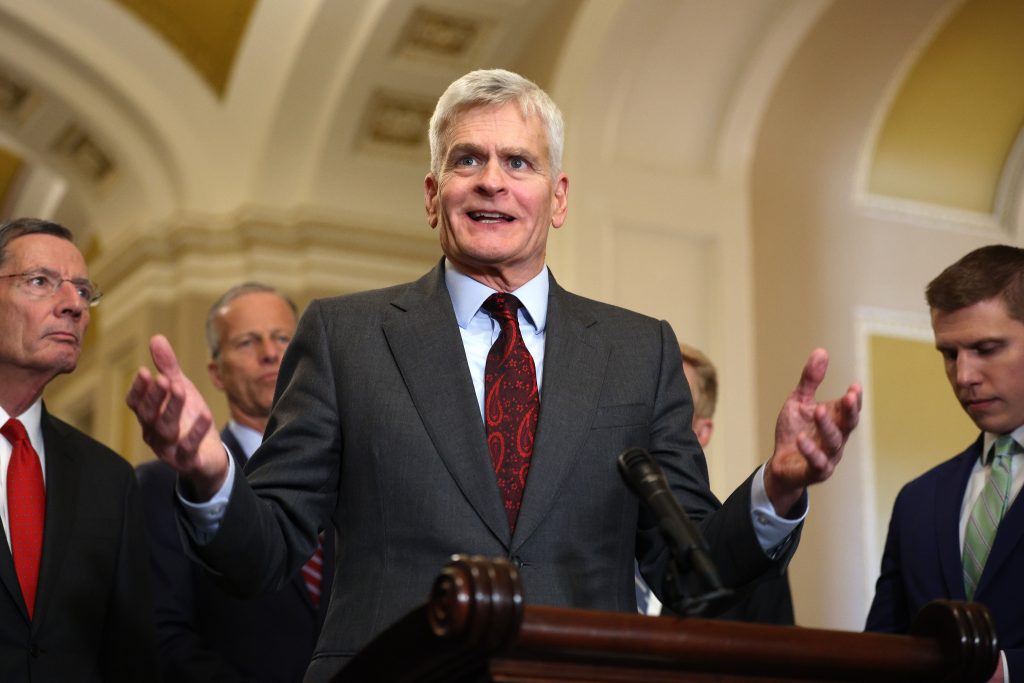
Sen. Bill Cassidy’s reelection fight in Louisiana has become a high-stakes test of loyalty and leadership, with Rep. Julia Letlow and former Rep. John Fleming pressing hard against an incumbent who once voted to convict Donald Trump. The race, shaped by Gov. Jeff Landry’s decision to shift the state’s primary rules and by heavy outside spending, paints a picture of conservative infighting played out in Baton Rouge and beyond.
Cassidy is running on a record of legislation and results, arguing that steady experience beats drama. He admits his 2021 impeachment vote “might” be a liability, but he points to a history of getting bills over the finish line and working inside the system to pass meaningful policy. That pragmatic, results-first message appeals to voters who want senators who actually deliver.
Julia Letlow, carrying President Trump’s endorsement and a political brand sharpened by MAHA-aligned supporters, casts herself as the truer MAGA choice. Trump wrote, “I know Julia well, have seen her tested at the highest and most difficult levels, and she is a TOTAL WINNER! A Proud Mother of two children, Julia is a wonderful person, has ALWAYS delivered for Louisiana, and would continue doing so in the United States Senate.” That backing gives her a clear lane with the party base.
John Fleming stays in the mix as a conservative alternative, unabashedly courting grassroots voters who worry about energy policy and federal overreach. Fleming has framed himself as the only “true conservative” in the field and has tried to capitalize on local anger over carbon capture rules. He also says he turned down a White House offer to exit the race, a claim that keeps his supporters energized.
Political leaders have been cautious about picking sides, with Senate Republicans broadly supporting incumbents. “Bill Cassidy has been a terrific senator for Louisiana,” Senate Majority Leader John Thune told reporters Thursday. That institutional support matters in Washington, but on the ground Louisiana voters are making their own calculation about who best represents conservative priorities.
Gov. Jeff Landry changed the game by moving Louisiana away from a jungle primary toward closed partisan primaries, a shift Cassidy argues has hurt his chances with unaffiliated voters. On the campaign trail Cassidy complained that the new system was confusing, saying, “People are calling my office to say they tried to vote for me, but they could not. ” His team, including campaign manager Kate Larkin, has been blunt about the governor’s influence: “It’s not an accident that voters are confused by this intentionally difficult process,” Cassidy campaign manager Kate Larkin wrote in a statement shared with NBC News.
The race has a flavor of intra-party punishment for those who bucked Trump. After Jan. 6, the handful of Republicans who voted against and convicted the former president dwindled in power, and Cassidy’s vote still looms large to many primary voters. Still, Cassidy highlights the practical side of governance—committee work, policy wins, and Senate relationships—as what Louisiana needs more than posture.
Healthcare and vaccine debates have added another layer to the contest. Cassidy, who leads the Senate Health, Education, Labor and Pensions Committee, clashed publicly with Health Secretary Robert F. Kennedy Jr. over vaccine skepticism while also casting the vote that put Kennedy in place. That nuanced posture left him open to attack from MAHA supporters, and MAHA PAC spent heavily to boost Letlow’s bid to unseat him.
Campaign spending in this three-way fight has been massive and telling. Overall spending has topped $30 million. Ads in support of Cassidy have totaled $21.8 million, with another $9.8 million in ads boosting Letlow and $1.5 million in spending on pro-Fleming ads. Those dollars show who’s mobilizing resources and how badly different factions want control of the seat.
In the closing days Letlow leaned into the MAHA message and targeted Cassidy over past votes and private sector decisions, while Cassidy attacked her record on stock trades and earlier support for diversity initiatives in academia. He has repeatedly warned that the race could slip away, calling it “Letlow’s to lose,” but he also expressed confidence about surviving either a straight win or a runoff, saying, “She is the person to beat,” he said on a call with reporters in early May, adding that if Letlow “doesn’t make the runoff … then I would be in against Dr. Fleming, and we would have accomplished our mission.”
National Republicans have stayed largely neutral, and that silence has allowed local dynamics to dominate. House Speaker Mike Johnson struck a personal tone when asked about the contest: “Julia is like a sister to me. We’re very close,” he told NBC News earlier this week. “My awkward situation is I’m also close to the other candidates. John Fleming was my predecessor and was the first person who endorsed me to take this seat, and of course I’ve worked well with Sen. Cassidy.”
Saturday’s primary will tell whether a record of governing and negotiation holds weight in a GOP electorate driven by loyalty and cultural signals. For Cassidy, the path forward depends on persuading conservatives that steady, experienced leadership still matters in Washington and in Louisiana’s Baton Rouge corridors of power.