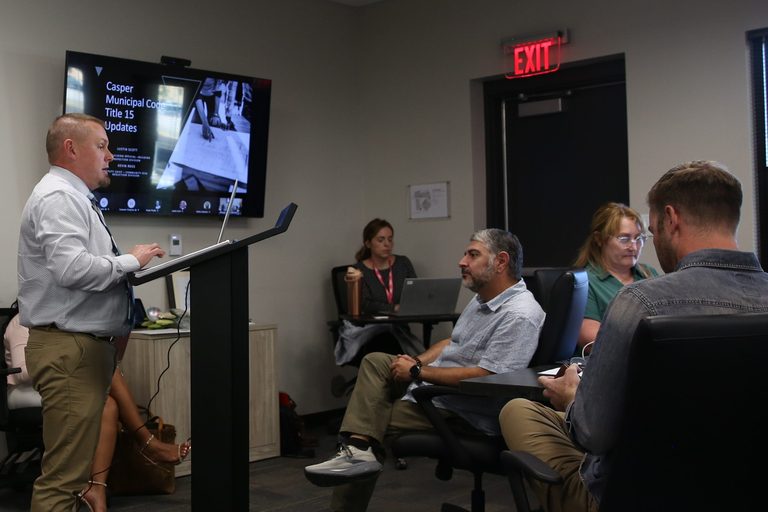
CASPER, WY — City leaders are considering a sweeping update to Casper’s building and construction regulations that would require active contractors to complete four hours of continuing education annually. The proposal, discussed during a City Council work session on Tuesday, also seeks to add new licensing classifications, streamline outdated code sections, and adjust plan‑review fee calculations.
Continuing education requirement
Chief Building Official Justin Scott explained that while Wyoming law mandates 16 hours of continuing education every three years for electrical contractors, other trades face no state‑level requirement. “Nearby states like Colorado, South Dakota, Utah and Idaho already enforce regular continuing education standards for general trades,” Scott said. The four‑hour annual requirement is presented as a modest threshold to keep tradespeople current on evolving technical codes.
Councilor Pat Sweeney voiced concern that the mandate could push contractors out of business, saying, “I just don’t want to regulate our contractors out of business so we have nobody left to do the work.” In response, Scott noted that many contractors already engage in industry training and argued the low threshold would not be burdensome.
Mayor supports the change
Mayor Ray Pacheco backed the education requirement, comparing it to the 70‑hour continuing‑education demand placed on licensed therapists. “Four hours a year is not an imposition on anybody,” the mayor said, emphasizing the importance of staying up‑to‑date in a field that impacts public safety.
Expanded licensing categories
The proposal would create specific license categories for cellular communications, framing, drywall, insulation, and both flatwork and general concrete work. It also calls for the removal of obsolete classifications such as high‑ and low‑pressure boiler operators and gasfitters, reflecting technological advances that have rendered those roles unnecessary.
Code clean‑up and renewable energy updates
Several local amendments to the 2026 National Electrical Code would be eliminated now that Wyoming has adopted the new edition. The plan also expands regulations for renewable‑energy systems, adding wind‑energy guidelines and clarifying permitting, plan‑submittal, and inspection requirements for solar installations.
Fire‑protection trades, including fire‑alarm and sprinkler systems, would face new licensing, inspection, and permitting requirements, aligning Casper with existing regulations in Cheyenne and Natrona County.
Dangerous‑building provisions
City officials propose adopting the 1997 edition of the Uniform Code for the Abatement of Dangerous Buildings, which Scott says is the most recent version. Since 2023, Casper has addressed 22 dangerous buildings, resolving 14 cases, demolishing nine structures, and renovating six. The city spent $57,270 on abatement and recovered $29,265 through liens and cost‑recovery actions.
Plan‑review fee restructure
Under the current system, a flat $280 plan‑review fee applies to new single‑family homes, while commercial projects pay a fee equal to 65% of the building‑permit fee for projects valued at $25,000 or more. The proposed revision would set a uniform fee of 40% of the building‑permit fee for both residential and commercial projects over $25,000.
Community Development Director Liz Becher noted that the change is expected to shift revenue patterns: commercial plan‑review revenue may decline, while residential revenue could rise. Using fiscal year 2025 as a baseline, the new structure would increase combined plan‑review revenue from $213,999.87 to an estimated $225,948.24.
Next steps
No final vote was taken at the Tuesday meeting. Vice Mayor Kyle Gamroth said he will wait for a detailed, red‑lined version of the ordinance before deciding. Additional councilors and city staff indicated they will continue the discussion at a future work session.
Original reporting: Oil City News (Casper WY) — read the source article.