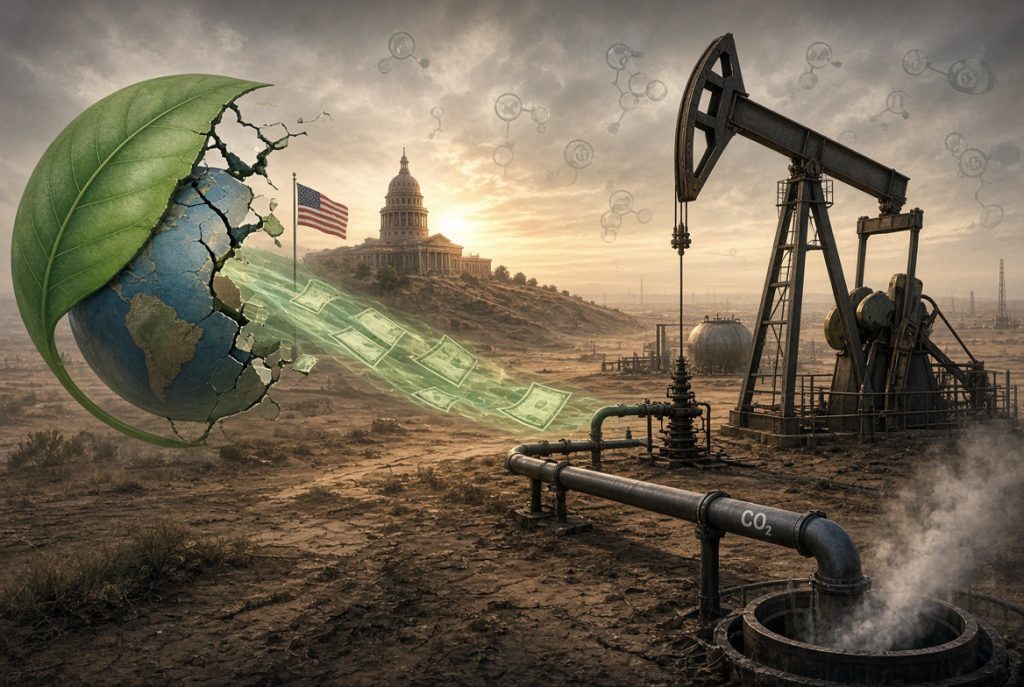
Carbon capture and sequestration (CCS) is routinely sold to the public as an urgent technological fix required to “save humanity” from atmospheric CO₂. In practice it has functioned as a large-scale public subsidy that makes enhanced oil recovery (EOR) more profitable for the oil and gas industry. The sequence of events, the economic thresholds, and the scientific numbers on CO₂ concentrations do not support the most dramatic political claims that accompanied the policy push. When those claims are stacked against the record, a consistent pattern of overstatement and selective framing emerges from the politicians who shaped the hearings and the resulting incentives.
Carbon capture and sequestration (CCS), often marketed as an essential climate solution, functions in practice as a substantial public subsidy that props up enhanced oil recovery (EOR) for the oil and gas sector. The technology and economics did not suddenly appear because of existential climate alarms; they evolved from longstanding industry practices that treated CO₂ as a useful injectant for squeezing more crude from aging fields. What changed was the scale of government payments that made the process far more profitable.
The 2007 Recognition: CO₂ as an Oil Boon
In September 2007, the Christian Science Monitor published “Climate-change paradox: Greenhouse gas is Big Oil boon.” The piece described how oil companies were already injecting CO₂ into declining West Texas fields (such as SACROC) to boost production after primary and secondary (waterflood) recovery had run their course. Natural CO₂ from underground deposits in Colorado was piped to the Permian Basin. Industry figures noted that EOR accounted for only a modest share of U.S. output at the time—around 240,000 barrels per day—but the potential was large. The U.S. Department of Energy estimated that sufficient man-made CO₂ could help recover tens of billions of additional barrels and potentially quadruple recoverable reserves in some scenarios.
Companies were already looking beyond natural sources. Projects were discussed that would capture CO₂ from fertilizer plants, power stations, and other industrial facilities and sell it for EOR. Environmental groups at the time sometimes framed this as a bridge to pure geological sequestration. Critics pointed out the obvious: producing and burning the extra oil releases CO₂ roughly equivalent to (or greater than) what was injected, so the net climate benefit was questionable at best. The core commercial reality was straightforward—CO₂ flooding worked for oil recovery when the gas was cheap enough relative to oil prices.
Historical market prices for CO₂ delivered for EOR were often in the teens to low tens of dollars per ton when sourced from natural reservoirs or low-cost industrial byproducts. Analyses from that era and later showed that making captured anthropogenic CO₂ economic for widespread EOR frequently required higher effective prices—commonly cited in the range that made a support level around $60–65 per ton (or higher, depending on oil prices, transport, and recycling costs) the difference between marginal and attractive projects. Without external support, pure capture-and-store operations struggled; pairing them with oil production improved the numbers.
Fifteen Years Later: The Policy Pivot and the Subsidy
By the early 2020s the framing had inverted. Governments declared an urgent need to extract as much CO₂ as possible from the atmosphere and industrial sources “to save humanity.” Public hearings proliferated on the best ways to dispose of captured CO₂. Into this policy environment stepped the oil and gas industry with a ready solution: inject the gas deep into the ground using existing wells and depleted reservoirs—the same infrastructure already proven for EOR. The government response included substantial tax credits under Section 45Q of the U.S. tax code.
Under the Inflation Reduction Act framework and subsequent adjustments (including parity changes in later legislation), the credit reached levels on the order of $60 per metric ton for CO₂ used in EOR (with higher figures, often $85, available for pure geological storage or when prevailing-wage and apprenticeship requirements were met; direct-air-capture projects received still higher rates). Recent changes have moved toward parity at the higher end for utilization including EOR. These figures align closely with the economic threshold long identified as necessary to make large-scale captured-CO₂ EOR commercially robust. The result is public money flowing to projects that simultaneously store CO₂ (at least temporarily or partially) and produce additional oil.
This is not accidental synergy. It is the logical endpoint of turning a decades-old oilfield technique into a climate-policy vehicle. Capture costs at power plants and heavy industry remain high; the subsidy bridges the gap and creates a revenue stream for operators who already understand subsurface injection.
The Unanswered Question on the Stage
In public forums and hearings, the discussion often stayed at a high level of urgency. I shared stages with PhD professors and technical professionals who emphasized the dangers of rising CO₂. When I asked for concrete thresholds—how much atmospheric CO₂ is “too much” for humanity, and how much is “too little” for plants to thrive and reproduce—the consistent reply was that the issue was too complicated for simple numbers. My response was that complexity often tracks with who is funding the study. Science that produces clear, actionable thresholds is less convenient for expansive policy programs.
The Actual Numbers on CO₂
Atmospheric CO₂ currently sits near 429 ppm (global averages in the high 420s as of mid-to-late 2026.
Commercial greenhouse and indoor grow operations routinely enrich CO₂ to 800–1,500 ppm and often higher (1,800 ppm or more) because net photosynthesis and growth rates for most crops respond positively well above ambient levels. Yields, leaf size, and development speed improve; the economic case for enrichment is well established in controlled-environment agriculture.
Workplace safety standards tell a different story from the catastrophic rhetoric. OSHA’s permissible exposure limit is 5,000 ppm as an 8-hour time-weighted average. Significant physiological effects (increased respiration, headache, discomfort) become more pronounced in the 10,000–20,000+ ppm range with longer exposure; the NIOSH immediately-dangerous-to-life-or-health level is 40,000 ppm. CO₂ is not a conventional toxin at ordinary outdoor concentrations.
On the low end, C3 plants (the majority of crops and vegetation) experience severe stress, reduced growth, and compromised reproduction as concentrations approach or fall below roughly 150–200 ppm. Glacial-period levels of ~180–190 ppm already imposed carbon limitation on modern genotypes in experimental settings; the CO₂ compensation point for net photosynthesis in many C3 species lies near or below 100 ppm under typical conditions. We are currently far closer, in relative terms, to the point at which open-field plant productivity would suffer than to any acute human toxicity threshold.
Who Benefits from the Narrative?
Profit and institutional incentives explain the persistence of the extreme framing better than the raw atmospheric numbers. Large-scale indoor hydroponic and vertical-farm operations can (and do) push CO₂ well above 1,000–1,800 ppm to accelerate growth under artificial lighting. They are insulated from outdoor atmospheric trends. Small conventional farms and open-field agriculture, by contrast, depend on ambient CO₂. Policies that treat every incremental ton of atmospheric CO₂ as an urgent threat, while simultaneously subsidizing its capture and underground injection for oil production, create winners and losers. The winners include operators who receive the tax credits and the additional oil revenue; the losers include those whose competitiveness depends on natural outdoor conditions and who do not capture equivalent subsidies.
Carbon capture is not primarily a climate silver bullet. It is a mechanism that converts public fiscal support into infrastructure and revenue for the oil and gas industry while allowing continued (and in the EOR case, expanded) fossil-fuel production under a green banner. The 2007 industry interest in cheap CO₂ for floods, the subsequent elevation of the required price point through policy, the hearings that sought disposal solutions, and the eventual generous per-ton payments form a coherent arc. The scientific thresholds for plant productivity and human occupational safety remain stubbornly inconvenient for the most alarmist versions of the narrative. When the numbers are examined directly rather than filtered through funding-dependent complexity, the distance between current conditions and genuine existential risk to either food supply or human health is far greater than the policy urgency implies.
Politicians are not salespeople. Their role is not to market a preferred policy outcome with selective emphasis and convenient omissions. When they stand in hearings, on stages, or in official statements and present carbon capture primarily as an urgent planetary rescue mission while systematically downplaying or ignoring its origins as an enhanced oil recovery technique, its dependence on taxpayer subsidies calibrated to industry economics, and the actual atmospheric concentration data that contradict the most catastrophic framing, they are misrepresenting the facts. That is lying.
The end does not justify the means. Claiming that exaggerated urgency or incomplete disclosure is acceptable because the climate stakes are high simply repeats the oldest rationalization for deception in public life. Citizens are entitled to an accurate accounting of the technology’s history, costs, dual-use nature, and the real thresholds for both plant productivity and human safety. When officials instead deliver a simplified narrative that treats current CO₂ levels as an immediate existential poison, treats the oil-and-gas industry’s ready infrastructure as a pure public-interest solution, and treats the resulting per-ton payments as climate policy rather than a subsidy for additional oil production, the record shows a consistent pattern of misrepresentation.
This is not a matter of reasonable disagreement over complex science. The 2007 public reporting on CO₂ floods for oil recovery, the economic analyses identifying the price points needed to make captured CO₂ attractive for EOR, the structure of the 45Q credits, and the established concentration thresholds for greenhouses, workplaces, and plant growth were all available. Choosing to emphasize only the emergency framing while omitting or minimizing those elements is not simplification for clarity. It is the substitution of a preferred story for the fuller set of facts. Public officials who do so have not merely “spun” or “framed.” They have lied to the people they are sworn to serve.
Support our efforts to bring the simple truth to life by subscribing to our newsletter: https://open.substack.com/pub/matlock4texas28