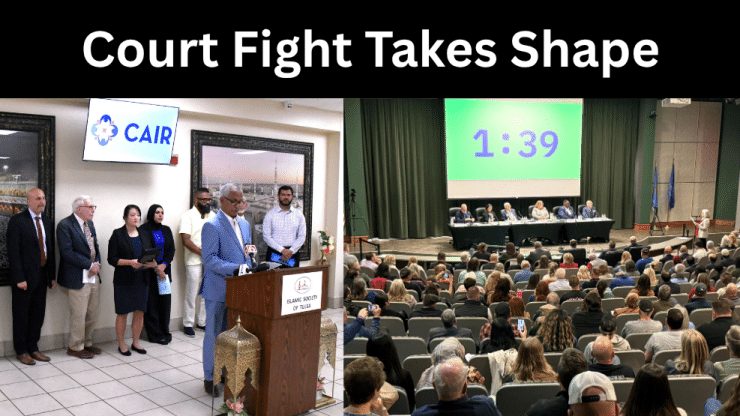
Broken Arrow City Council members Lisa Ford, David Pickel and Justin Green, along with Mayor Debra Wimpee, have stood by their recent denial of a rezoning request and conditional use permit for the Islamic Society of Tulsa (IST). The council cited concrete infrastructure problems – lack of sewer service, a single entrance and exit, and a two‑lane Olive Avenue that feeds onto the Creek Turnpike – as the primary reasons for rejecting the application.
Legal challenge asserts religious discrimination
IST, represented by the Council on American‑Islamic Relations (CAIR), filed a federal lawsuit alleging the council’s decision violates the Religious Land Use and Institutionalized Persons Act (RLUIPA). The plaintiffs claim the council acted with “unlawful animus” toward Muslims, pointing to emails from Mayor Wimpee and Councilwoman Ford that expressed concerns about the motivations or alleged violent tendencies of Muslims who have moved into other communities.
In response, the city’s attorneys moved to dismiss the suit, arguing that council members enjoy legislative and quasi‑judicial immunity that shields them from lawsuits over zoning and land‑use decisions. The city maintains that such immunity applies only when officials act in a legislative capacity to pass general laws, not when they make case‑by‑case determinations about specific parcels of land.
Council’s legal position
Council counsel contended that the denial was a specific, administrative action rather than a legislative one, and therefore the immunity defenses do not apply. The motion emphasizes that the property in question lacks any inherent religious significance and that no alternative sites were shown to be unavailable, making it difficult for IST to meet the “substantial burden” standard under RLUIPA.
“The denial of a specific land‑use application under the circumstances here – where the subject property lacks any particular religious significance of its own, and where there is no allegation regarding the unavailability of other sites – cannot clear the bar for substantial burden claims,” the city’s motion states.
Broader implications
The dispute arrives as the U.S. Supreme Court prepares to hear a separate case involving a Kentucky church’s effort to build a prayer grotto on its property. That case will address how courts determine whether a land‑use restriction creates a “substantial burden” on religious exercise under RLUIPA. Legal analysts, including Ryan Gardner of the First Liberty Institute, warn that the outcome could set a nationwide standard affecting churches, synagogues, ministries and other faith‑based organizations.
While the Supreme Court case focuses on a Catholic shrine, Gardner notes that the principles at stake extend far beyond any single religious group. “An overly narrow interpretation of the federal law could have dire consequences for religious land use around the country,” he told Fox News Digital.
Local perspective
Broken Arrow residents have long praised the city for its diverse array of houses of worship. Council members argue that maintaining that tradition does not require compromising essential infrastructure standards. They assert that the city remains committed to protecting the rights of all faith communities while ensuring public safety and proper municipal planning.
The lawsuit remains pending, and the court will need to decide whether the council’s actions fall within the protective scope of legislative immunity or constitute a violation of federal religious‑land‑use protections.
Original reporting: Broken Arrow Sentinel — read the source article.