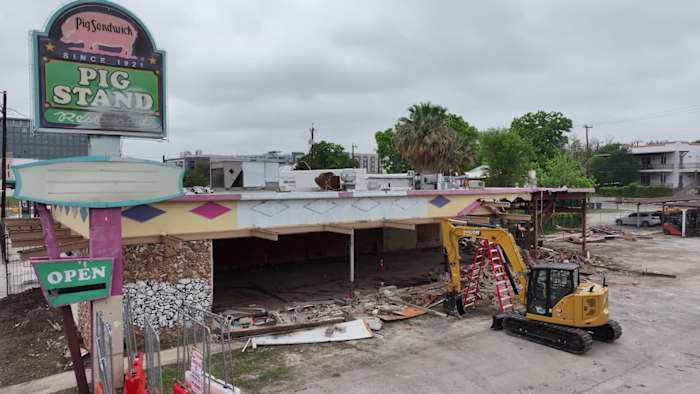
Broadway in San Antonio is shifting fast, with familiar spots falling and big new projects reshaping the stretch from downtown through Midtown to Pearl. This piece looks at recent high-profile changes including the demolition of the historic Pig Stand, the planned 211-room hotel on that site, the “BESA” Broadway East San Antonio mixed-use proposal, construction tied to Terry Black’s BBQ and hotel near Pearl, and the closing of Good Time Charlie’s after decades on Broadway.
For more than a century the Pig Stand marked the edge of downtown life, a touchstone for generations of San Antonians. Crews recently took down the building, and developers have eyes on a 211-room hotel for that parcel. The loss is visceral for people who grew up with that neon and that quick-service tradition, while others see a skyline gap that will soon be filled with new vertical density.
Heading north, the Broadway corridor has collected momentum as a place investors want to densify and connect. The “BESA” Broadway East San Antonio proposal cleared initial design approvals in early 2025 and positions itself as a wide-ranging development. Plans call for mixed uses that mix homes with shops, offices and hospitality to boost walkability and keep more life on the street after 5 p.m.
That focus on mixed-use is intentional: city leaders and developers want Broadway to knit downtown, Midtown and Pearl into a continuous urban spine. The logic is simple – more homes, retailers and offices in close proximity will support transit and small businesses. It also aims to swap surface parking and one-story sprawl for layered buildings that create sidewalks people want to use.
Near Pearl, the first phase of the Terry Black’s BBQ restaurant and hotel project is underway, and that pairing tells you a lot about the new Broadway. Bringing a well-known Texas barbecue brand together with a boutique hotel signals a push for destination dining and overnight stays. The development also adds commercial space that aims to capture foot traffic from the nearby River Walk-adjacent attractions.
Those investments do not erase nostalgia. Good Time Charlie’s Bar and Cafe closed after more than 45 years, leaving an emotional hole for families and students who counted decades of meals and memories there. The shuttering of long-running local businesses is part of the churn that comes with rapid redevelopment, and it spotlights the tensions between growth and cultural continuity. For many residents, the question is how to keep the corridor’s character while accommodating change.
A lot of the planning emphasis is on walkability and creating street-level energy, not just adding structures. Developers pitch projects that promise retail storefronts, café space and pedestrian-friendly sidewalks to keep Broadway vibrant. That approach is meant to ensure new residents and visitors alike have reasons to linger rather than simply drive through.
What’s happening on Broadway is also a capital play. Hotels, residential towers and new restaurants translate into tax revenue, jobs and a broader nightlife economy. But the economics can squeeze legacy operators who face rising rents and competition for prime frontage. Local officials are juggling incentives and regulations as they try to balance development goals with preserving affordable commercial space.
The Pearl district exerts a gravitational pull on nearby projects, which is why so many plans cluster in that area north of downtown. Pearl’s success as a mixed-use destination creates demand for adjacent housing and hospitality, and Broadway becomes the natural conduit. As projects like “BESA” and the Terry Black’s development move forward, the corridor is absorbing more of the city’s growth energy.
Residents react in different ways to these changes depending on what they value most. Some welcome the new amenities, hotels and housing options that can activate the street and support local businesses. Others worry about displacement, loss of heritage establishments, and whether the new development will actually serve long-term residents rather than only visitors and newcomers.
City planning efforts around Broadway emphasize connectivity between neighborhoods, aiming to reduce car dependence and encourage more mixed-use nodes. That means more emphasis on sidewalks, bike infrastructure and parking strategies that prioritize density-friendly transit. The goal is a corridor where people can live, work and play without relying entirely on cars.
For developers, Broadway is attractive because it links key urban anchors and has room to grow compared with downtown’s already-dense blocks. Combining residential units with offices and hotels makes projects more financially viable and can unlock private capital. Those same market dynamics are why long-time businesses sometimes find it hard to compete for space and attention.
As demolition, approvals and construction ripple along Broadway, the corridor’s next phase is being written in concrete and glass. The Pig Stand’s absence and the coming 211-room hotel, the “BESA” plans, the Terry Black’s build-out and Good Time Charlie’s closure are all chapters in that story. What remains uncertain is how the neighborhood will retain its local flavor amid the new skyline and shifting street life.