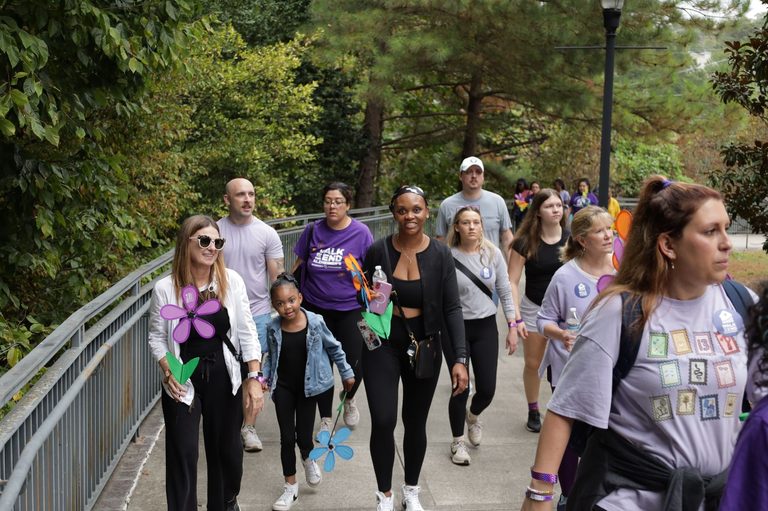
On Oct. 31, hundreds of Atlantans assembled in Piedmont Park for the Alzheimer’s Association’s annual Walk to End Alzheimer’s, a community‑focused event organized by the organization’s Georgia chapter. The walk highlighted the personal stories of families like that of W. Imara Canady, whose 82‑year‑old mother, L.M. Jamila Canady, was recently diagnosed with dementia after a serious fall.
Local families lead the effort
Canady, the sole caregiver for his mother, described the emotional challenge of accepting her diagnosis and the isolation that often accompanies the disease. He said, “I realized about a month ago that I could finally verbalize that my mother had dementia, which was very difficult for me.” In honor of his mother—known in the West End as the “Queen of the West End”—Canady formed a fundraising team called “Jamila’s Angels.” The team quickly surpassed its initial $2,000 goal and is now approaching an $8,000 target ahead of the walk.
Community impact and statistics
According to the Alzheimer’s Association’s 2026 Facts and Figures report, an estimated 7.4 million Americans age 65 and older live with Alzheimer’s disease, including roughly 188,000 residents of Georgia. The report also notes that 391,000 Georgians provide unpaid care for loved ones with dementia, underscoring the disease’s broad reach beyond those directly diagnosed.
Clay Jacobs, executive director of the Alzheimer’s Association’s Georgia chapter, emphasized that Alzheimer’s is a disease that affects entire neighborhoods. He explained, “When somebody first notices symptoms, they don’t come to us. They often turn first to their community.” Jacobs also clarified the distinction between Alzheimer’s disease—a specific condition and the most common cause of dementia—and the broader umbrella term “dementia,” which describes a range of memory and thinking impairments.
Health disparities and emerging treatments
The association highlighted that older Black Americans are about twice as likely as older white Americans to develop Alzheimer’s or another form of dementia, and that women represent nearly two‑thirds of all Americans living with the disease. Despite these challenges, Jacobs pointed to recent advances that are offering new hope. New blood‑based tests now enable earlier diagnosis, and FDA‑approved medications can slow disease progression for patients identified in the earliest stages.
Jacobs urged residents to adopt lifestyle habits that reduce cognitive decline risk, including regular exercise, balanced nutrition, social engagement and mentally stimulating activities.
Fundraising goals and community partnerships
The Atlanta walk set a $700,000 fundraising goal to support research, respite care, educational programming and caregiver services. Jacobs reported that the association is funding more than $2 million in research projects within the Atlanta area this year.
The event featured children’s activities, a tribute wall and a “Promise Garden” ceremony where participants displayed colorful pinwheel flowers symbolizing their personal connections to Alzheimer’s. “It’s the largest support group you have all year, but it’s also a celebration,” Jacobs said.
Beyond the walk, the Alzheimer’s Association collaborates with local partners such as Atlanta Housing to provide brain‑health education and connect residents with resources. Families seeking assistance can call the free, 24‑hour helpline at 800‑272‑3900 or visit alz.org for additional information.
Turning personal loss into community service
For Canady, the walk transformed the pain of his mother’s diagnosis into a purpose that reaches beyond his family. Through Jamila’s Angels, the spirit of service his mother embodied continues to inspire others, one step at a time.
Original reporting: SaportaReport — read the source article.