Asian markets experienced a downturn on Thursday, reacting to the U.S. military’s recent defensive strikes against Iran. The strikes, which targeted Iranian drones near the Strait of Hormuz, have led to a notable increase in oil prices, rising more than $1 a barrel.
Market Reactions
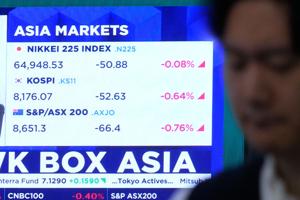
In early trading, Japan’s Nikkei 225 saw a slight increase of less than 0.1% to 65,039.78, while South Korea’s Kospi dropped by 1.2% to 8,126.67. Hong Kong’s Hang Seng index decreased by 1.9% to 24,855.86, and the Shanghai Composite index fell by 0.3% to 4,080.00. In Australia, the S&P/ASX 200 declined by 0.8% to 8,646.30, whereas Taiwan’s Taiex gained 0.6%.
U.S. officials reported that Central Command forces intercepted four Iranian attack drones and targeted a ground control station in Bandar Abbas to prevent the launch of a fifth drone. President Donald Trump commented that Iran is “negotiating on fumes” and emphasized that the upcoming U.S. midterm elections would not pressure him into hastily concluding the conflict.
Oil Price Fluctuations
Oil prices, which had previously dropped sharply, saw a resurgence following the strikes. Brent crude oil rose by $1.70 to $93.95 a barrel, while U.S. crude increased by $1.68 to $90.36. The recent ceasefire between the U.S. and Iran had initially eased oil prices, but renewed military actions have caused fluctuations.
Despite the geopolitical tensions, U.S. stock markets reached new highs, with the S&P 500, Dow Jones Industrial Average, and Nasdaq composite all setting records. Companies with significant fuel expenses, such as Norwegian Cruise Line Holdings and United Airlines, saw their stocks rise, buoyed by hopes of lower oil prices reducing operational costs.
Economic Outlook
Market analysts remain cautious about the potential for a U.S.-Iran agreement, with conflicting reports on the deal’s progress. Tan Boon Heng of Mizuho Bank noted the challenges in reaching a compromise, despite both nations’ efforts to maintain indirect communication channels.
As the situation develops, investors and businesses worldwide are closely monitoring the impact of these geopolitical events on global markets and oil prices.
Original reporting: KTBS 3 (Shreveport) — read the source article.