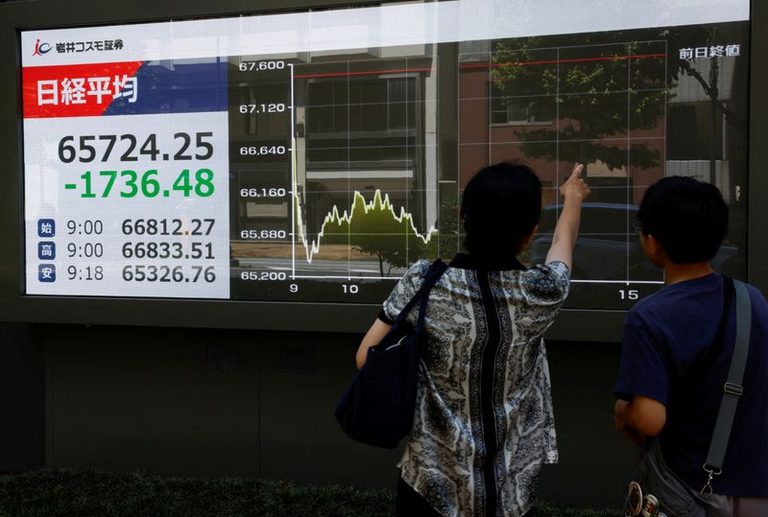
Share markets across Asia were largely unchanged on Monday, reflecting investor caution as the United States prepared to announce new sanctions on Iran and Nvidia’s quarterly results loomed. The flat performance came alongside a modest decline in oil prices, as traders priced in the potential impact of the sanctions.
Sanctions and oil market reaction
U.S. Treasury Secretary Scott Bessent is scheduled to hold a news conference later Monday to outline the forthcoming sanctions targeting Iran, which has continued to assert control over the strategic Strait of Hormuz. Brent crude fell 1.0% to $93.43 per barrel ahead of the announcement, after a 6.6% gain the previous week. U.S. crude futures slipped 1.1% to $86.14 a barrel.
Analysts noted that higher yields on 30‑year Treasury bonds, now at 5.2760%, remain close to the recent 19‑year peak of 5.3371%. Elevated yields increase the appeal of debt relative to equities and raise the discount applied to future earnings, underscoring concerns about stretched valuations in certain sectors.
Nvidia earnings expectations
The technology sector is holding its breath for Nvidia’s earnings report due Wednesday. Wall Street expects the chipmaker’s quarterly revenue to nearly double to about $92 billion, with full‑year earnings guidance projected between $103 billion and $105 billion. Investors recognize the difficulty of meeting such lofty forecasts given the company’s recent growth trajectory.
Fed outlook at Jackson Hole
Market participants also looked ahead to Federal Reserve Chairman Kevin Warsh’s speech at the Jackson Hole symposium in Wyoming on Friday. Warsh, known for avoiding forward guidance, may focus on the Fed’s balance‑sheet reduction agenda, which was highlighted in the July meeting minutes. JPMorgan chief economist Bruce Kasman warned that expectations of a strong Fed response could be underwhelming.
Current market pricing implies roughly a 40% probability that the Fed will raise interest rates at its September 16 meeting, with full pricing for a move by December. The odds could shift based on upcoming U.S. inflation data, as median forecasts for core inflation in July remain at 3.3%.
Currency and broader market moves
In currency markets, the U.S. dollar edged up 0.1% against the Canadian dollar, reaching 1.3784 after Canadian Prime Minister Mark Carney signaled that Canada would respond to U.S. tariffs with its own levies. Canada plans to impose tariffs on a range of U.S. goods, including steel, dairy, appliances, agricultural equipment, pulp and paper, and electronics.
Elsewhere, the dollar was flat at 159.00 yen, while the euro held at $1.1675 after a 0.9% rise the previous week. Investors remain wary that growing U.S. debt and policy uncertainty could erode the dollar’s purchasing power, prompting a shift toward safe‑haven assets such as gold, which rose 0.4% to $4,623 an ounce.
Regional equity performance
In Asia, the Nikkei index stayed near flat after a near‑4% decline last week. South Korean shares slipped 0.8%, and Taiwan’s market fell 0.5%. MSCI’s broadest Asia‑Pacific index outside Japan eased 0.2%.
European futures—including the EURO STOXX 50, DAX, and FTSE—were largely unchanged, while U.S. equity futures for the S&P 500 and Nasdaq traded slightly lower.
Original reporting: Appleton, WI News Feed (HLL/CB) — read the source article.