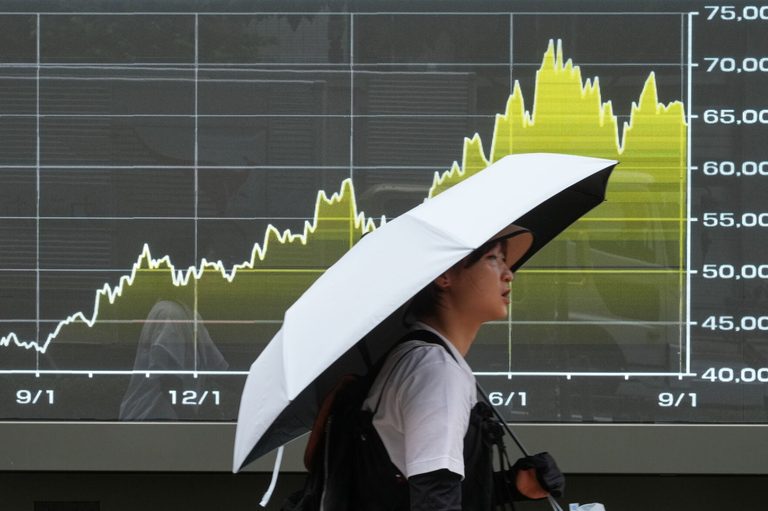
Tokyo and Seoul led global equity markets on Monday, with the Nikkei 225 climbing 2.1% to 66,399.84 and South Korea’s Kospi jumping 4.6% to 6,995.39. The rally was powered by a wave of buying in computer chip stocks.
Shares of Samsung Electronics surged 5.7% and memory‑chip leader SK Hynix rose 8.1%. Japan’s Renesas Electronics added 3.1%, Rohm Co. climbed 7.8% and Tokyo Electron edged up 4.7%, underscoring the strength of the semiconductor sector.
“The AI complex continues to provide the local equity markets with its most dependable growth pulse,” said former trader Stephen Innes, noting that artificial‑intelligence‑related hardware remains a key driver for investors despite broader valuation concerns.
In Europe, France’s CAC 40 was largely unchanged, inching up less than 0.1% to 8,282.06. Germany’s DAX slipped 0.2% to 25,993.23, and Britain’s FTSE 100 fell 0.2% to 10,814.01.
U.S. markets were set to drift lower, with Dow futures down 0.3% at 53,273.00 and S&P 500 futures little changed at 7,721.75.
Hong Kong’s Hang Seng lost 0.9% to 25,413.12, while the Shanghai Composite edged up less than 0.1% to 3,932.70. Australia’s S&P/ASX 200 was essentially flat, rising less than 0.1% to 9,010.90.
Energy and geopolitical backdrop
Brent crude added four cents, trading at $96.32 a barrel, as the six‑month U.S. conflict with Iran continued to influence oil markets. The United States military denied Iranian claims that an uncrewed American vessel had been struck in the Strait of Hormuz, calling the allegation a “total lie.” A senior Iranian official indicated Tehran plans to establish an “exclusion zone” around the strait, following recent U.S. strikes on three Iranian oil tankers in retaliation for missile launches aimed at U.S. warships.
U.S. benchmark crude fell 29 cents to $91.19 a barrel.
Monetary policy outlook
Market participants expect the Federal Reserve to raise interest rates before year‑end in an effort to cool inflation, which remains well above the 3% target. The Fed’s next policy meeting concludes on September 16, with a stated goal of bringing inflation down to 2%. August inflation data are due on September 11.
Currency movements
The U.S. dollar slipped to 155.95 yen from 156.22, while the euro rose modestly to $1.1634 from $1.1621. The weakening yen has been a concern for Japanese policymakers, who noted the currency’s recent rebound after the dollar briefly breached the 160‑yen level last week. Analysts are watching the Bank of Japan’s upcoming policy board meeting for clues on future rate direction.
“The stronger‑than‑expected U.S. employment report generated only a limited recovery in the dollar, suggesting the market is responding more to the changing BOJ outlook,” said Linh Tran, a market analyst at XS.com.
U.S. markets will be closed on Monday for the Labor Day holiday.
Original reporting: KTBS 3 (Shreveport) — read the source article.