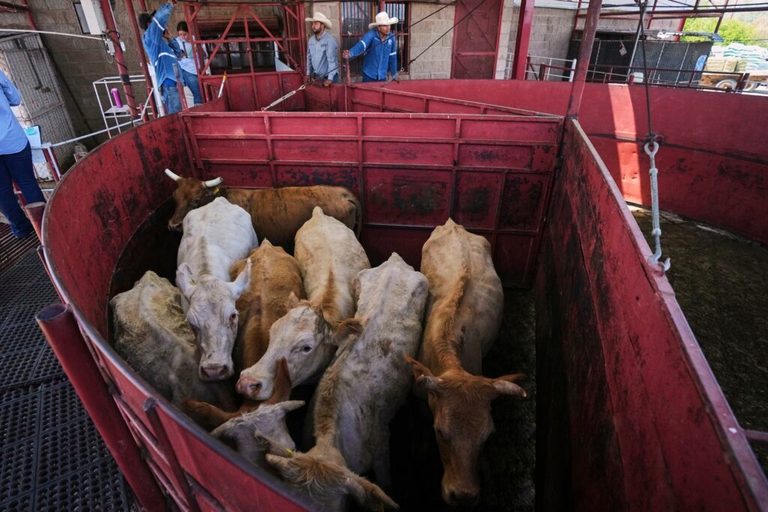
The U.S. Department of Agriculture announced that the Douglas, Arizona border crossing will resume receiving cattle from Mexico on Monday. The move is part of President Donald Trump’s broader strategy to address soaring beef prices that have strained family grocery budgets across the nation.
Why the crossing is reopening
Officials say the threat from the New World screwworm—a parasite that can kill livestock—has been reduced enough to allow cattle to cross safely. Each animal will be inspected and declared free of the parasite before entering the United States, according to Agriculture Secretary Brooke Rollins.
Rollins noted that the northern Mexican states of Sonora and Chihuahua have stronger animal‑health programs, making the Arizona crossing a logical first step. The USDA plans to phase in additional crossings in New Mexico and Texas over the coming months.
Economic context
Beef prices have risen dramatically over the past five years. The Bureau of Labor Statistics reports that the average price of a pound of ground beef jumped 57% from July 2021 to July 2026, reaching $6.89, while uncooked steak rose 35% to $13.06 per pound. Overall food prices increased about 25% in the same period.
President Trump recently announced a tariff‑free import of up to 331,000 tons of ground beef for a 90‑day period, hoping to bring lower‑priced meat to shelves. The reopening of cattle imports is intended to boost the domestic supply chain, but experts caution that any price impact will be modest and take time.
Expert opinions
Derrell Peel, an agribusiness professor at Oklahoma State University, said the administration has a strong incentive to claim action on high beef prices because the product is both expensive and highly visible to consumers. However, he expects “no measurable impact on cattle prices or beef prices soon,” noting that it will take months for Mexican imports to reach traditional levels.
Mexico typically supplies about 1.1 million head of cattle—roughly 3% of the U.S. supply. With the national herd at its lowest point in 75 years (86.2 million head as of Jan. 1), the additional 3% is unlikely to shift market dynamics dramatically.
Glynn Tonsor, an agricultural economics professor at Kansas State University, added that U.S. beef producers have become more efficient, extracting more meat per animal, which mitigates the effect of a smaller herd on prices.
Underlying challenges
The cattle shortage stems from a combination of drought in key grazing regions, low cattle prices over the past two decades, and the recent screwworm outbreak that forced a border closure in May 2025. Drought reduces pasture growth, forcing ranchers to sell livestock, while low prices have discouraged herd expansion for years.
Processing capacity is also constrained. Major meat processors such as Tyson Foods and JBS USA have announced plant closures in Nebraska, Utah, Illinois, and Pennsylvania, further limiting the ability to handle a larger supply of cattle.
Political response
U.S. House Agriculture Committee Chair John Boozman praised the “careful, science‑based” approach, calling the reopening “an important step for America’s cattle producers, especially our feeders in the border states.” The move aligns with the administration’s goal of strengthening the competitive beef industry while protecting animal health.
Nevertheless, Peel warned that “there’s nothing you can do” to bring prices down quickly, emphasizing that rebuilding the herd—a process limited by a cow’s one‑calf‑per‑year reproductive cycle—will take years.
What this means for families
For consumers, the immediate effect may be limited. While the policy reflects a concerted effort to address high meat costs, economists suggest that grocery‑store prices will likely remain elevated for the foreseeable future. Families should continue to monitor local market trends and consider alternative protein sources as the supply chain adjusts.
Original reporting: Alexandria, VA News – WTOP News — read the source article.