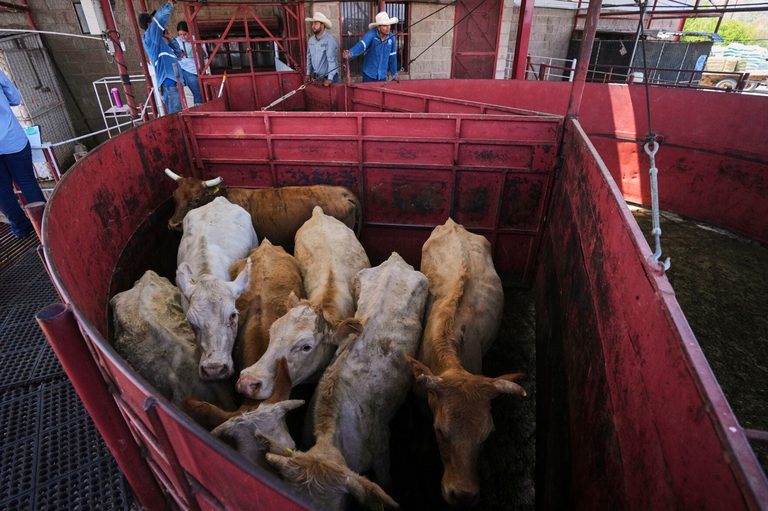
The U.S. Department of Agriculture announced that the Douglas, Arizona crossing on the U.S.-Mexico border will resume cattle shipments from Mexico on Monday. The move is part of a broader effort by the Trump administration to address soaring beef prices that have burdened families across the nation.
Why the reopening matters locally
Douglas, located about 230 miles southeast of Phoenix, will be the first of several border points to allow cattle movement after a closure in May 2025 that was intended to contain the New World screwworm parasite. Arizona ranchers and meat‑packing facilities hope the additional supply will help stabilize the regional cattle market.
Federal policy and economic context
President Donald Trump also announced a separate measure permitting up to 331,000 tons of imported ground beef to enter the United States tariff‑free for the next 90 days, with the goal of offering lower‑priced product to consumers. The administration argues that both steps are necessary to combat record‑high beef costs, which have risen sharply over the past five years.
Economists, however, caution that the impact on grocery‑store prices will be limited in the short term. Derrell Peel, an agribusiness professor at Oklahoma State University, noted that Mexico typically supplies about 3% of the U.S. cattle herd—roughly 1.1 million head. “I don’t expect to see any measurable impact on cattle prices or beef prices soon,” he said, adding that the phased reopening will take months to reach traditional import levels.
Underlying supply challenges
The United States entered 2026 with its cattle herd at 86.2 million head, the lowest figure in 75 years, according to USDA data. Drought in key grazing regions and two decades of low cattle prices have forced many ranchers to sell off animals, shrinking the herd further. The reduced supply has driven ground‑beef prices up nearly 57% from July 2021 to July 2026, reaching $6.89 per pound, while uncooked steak prices have climbed 35% to $13.06 per pound.
Industry efficiency gains have mitigated some pressure. Glynn Tonsor, an agricultural economics professor at Kansas State University, explained that modern processing techniques allow more meat to be harvested from each animal, lessening the price impact of a smaller herd.
Animal‑health safeguards
U.S. Agriculture Secretary Brooke Rollins emphasized that each animal will be inspected and declared free of the screwworm before crossing. The decision to start with the Arizona crossing reflects stronger animal‑health programs in the northern Mexican states of Sonora and Chihuahua.
U.S. House Agriculture Committee Chair John Boozman praised the “careful, science‑based” approach, calling the step important for cattle producers in border states and for maintaining a competitive beef industry.
Long‑term outlook
Rebuilding the national herd will take years, given that a cow typically produces only one calf annually. As Peel noted, breeding heifers removes them from the food supply, further tightening availability while the herd recovers. Until the supply chain stabilizes, high beef prices are likely to persist, leaving families to shoulder the cost.
For Arizona consumers, the reopening offers a modest, locally relevant development, but the broader economic forces shaping beef prices remain national in scope.
Original reporting: KTBS 3 (Shreveport) — read the source article.