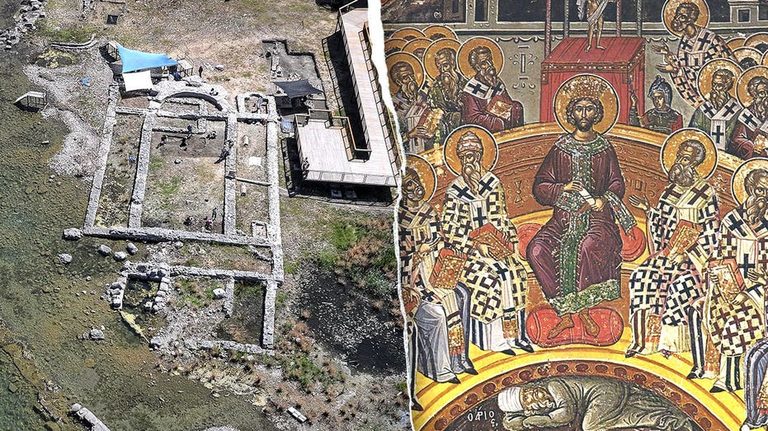
Archaeologists in Turkey believe they’ve made a groundbreaking discovery, possibly uncovering the remains of a church they believe hosted the First Council of Nicaea, one of the most pivotal events in the history of Christianity. The First Council of Nicaea, which took place in 325 A.D., was the first-ever ecumenical council in Christian history and famously produced the Nicene Creed, affirming that Jesus was ‘begotten, not made’ and fully divine rather than a created being.
Discovery Details
An international team of researchers in July excavated a church complex in the ancient city of Nicaea, now within the modern town of İznik. The building, which excavation director Mustafa Şahin identified as the Church of St. Neophytos, was destroyed by an earthquake in 368 A.D. and was later replaced by the Church of the Holy Fathers, built around 380 A.D.
Şahin told Turkish state media outlet Anadolu Agency that his team was tipped off to the existence of a smaller church after discovering that the floor paving extended beyond the walls of the existing basilica. The team began excavating east of the prothesis, outside the church’s exterior wall, and discovered that the floor paving continued beyond the existing church.
Nicaea is famous for hosting the First Council of Nicaea, which represented one of the earliest efforts to unify Christian doctrine across the Roman Empire. The council rejected the beliefs of Arius, who argued that Christ was a created being rather than co-eternal with God the Father.
Archaeologists first identified a large submerged basilica at the site in 2014, later determining it was the Church of the Holy Fathers. While that basilica has long been associated with the First Council of Nicaea, Şahin said the newly uncovered, smaller church beneath it is a more likely candidate to have hosted the council.
Original reporting: Fox News (HLL/CB) — read the source article.