The American flag remains one of the country’s most enduring and widely embraced symbols. As the United States marks the 250th anniversary of its founding, Old Glory will drape stages and line parade routes, flutter above the National Mall and serve as the backdrop to celebrations, speeches and moments of national reflection.
Unifying Threads
Every American flag starts the same way: with thread. Long before it becomes a symbol, the fabric that will become the flag is washed, inspected and checked for flaws. The material must be strong enough to endure wind and weather, but the biggest threat is the sun. Without UV-resistant fibers, the brilliant reds and deep blues that define the flag would quickly fade.
Parts of the flag are more structural than decorative, like the heavy-duty polyester canvas header, a reinforced strip that anchors the flag to a pole and helps it withstand years of outdoor use.
Stitching the Stars
The stars are sewn first. The Schiffli embroidery machine has replaced the hand sewing of the earliest American flags. Blue rectangles destined to become the top corner of the flag, called the canton, are fed into the towering machines, which stitch the familiar pattern of 50 white stars – alternating rows of six and five – with extraordinary precision.
Workers at Embroidery Solutions, a key supplier to Valley Forge, then inspect each canton by hand, searching for missing stitches, uneven spacing and other imperfections. Even minor flaws can send a piece back for rework before it becomes part of a finished flag.
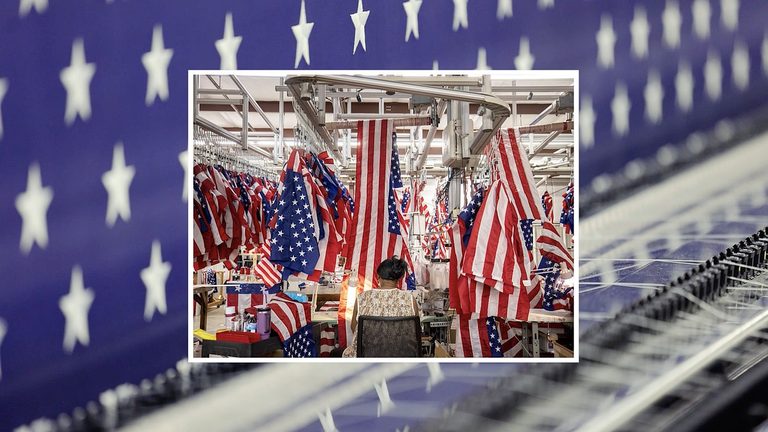
A flag comes into focus in a matter of moments, fabric becomes symbol. The strips of red and white nylon and a blue field of embroidered stars come together beneath the needle of a sewing machine. Workers carefully inspect the seams, ensuring the lines are straight, the fabric lies flat and the finished flag is sturdy enough to stand up to months of sun, rain and wind.
The final steps are less about appearance than endurance. Workers fold and stitch the flag’s edges to prevent fraying, then reinforce the fly end – the edge that will bear the brunt of the wind. At Lane Manufacturing in Lane, S.C., a partner of Valley Forge, the heavy canvas header is sewn along the hoist side, and metal grommets are pressed into place.
Original reporting: Texarkana Gazette — read the source article.