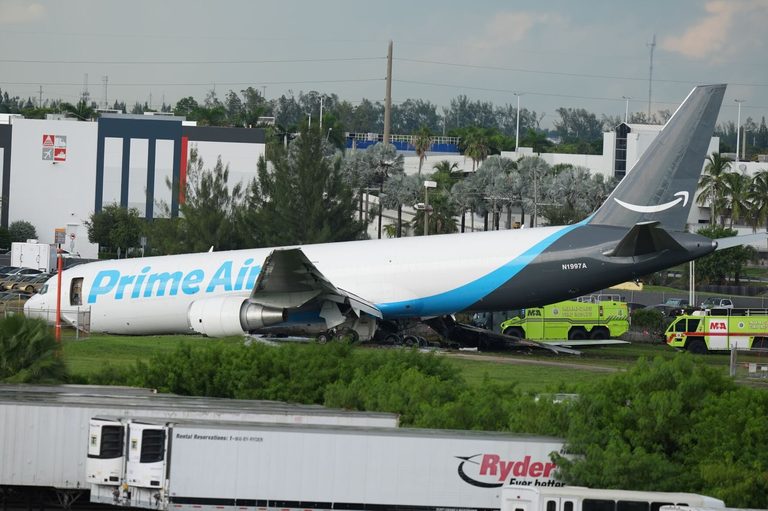
Miami, Fla. – A tragic aviation accident unfolded Sunday afternoon at Miami International Airport when a Boeing 767 cargo plane, part of Amazon’s Prime Air fleet and operated by North Carolina‑based 21 Air, overran the runway after landing from San Juan, Puerto Rico. The aircraft burst through the runway safety area, collided with a roadway used by warehouse workers and nearby trucks, and was engulfed in flames.
Casualties and emergency response
Miami‑Dade County officials confirmed that at least five people were killed and five others injured. Three of the injured remain in critical condition, while two were hospitalized with less severe injuries. The victims were a mix of vehicle occupants and possibly crew members, though officials have not yet determined whether the pilots survived the impact.
Rescue Fire Chief Ray Jadallah described the scene as “a massive fire with thick black smoke billowing into the sky.” Firefighters deployed specialized airport foam units to suppress the blaze and later worked to control a fuel leak that persisted for hours after the initial crash.
Impact on airport operations
The incident forced the closure of Miami International Airport for much of the afternoon, disrupting travel for thousands of passengers. FlightAware reported that more than 160 flights were canceled and nearly 325 were delayed. Some airlines rerouted flights to Orlando International Airport, located about 200 miles north.
Miami International is a critical hub for both passenger and cargo traffic in South Florida, serving as a gateway for commerce and tourism. The sudden shutdown highlighted the airport’s reliance on efficient emergency protocols and the importance of rapid coordination among local, state, and federal agencies.
Investigation underway
The National Transportation Safety Board (NTSB) has dispatched a team led by Chairwoman Jennifer Homendy to investigate the cause of the overrun. While the exact reason remains unknown, officials noted that thunderstorms and wind gusts up to 30 mph were recorded in the area at the time of the accident.
Aviation safety expert Steve Arroyo, a retired United Airlines pilot, questioned whether the aircraft landed within the required touchdown zone—typically the first 3,000 feet of a runway. Former Transportation Department Inspector General Mary Schiavo observed video footage showing the plane floating above the runway for an extended period without a proper flare, suggesting a possible misjudgment during the landing roll.
Safety infrastructure concerns
Miami International does not have an arresting system—beds of lightweight, crushable material installed at the ends of some runways to safely stop aircraft that overshoot. The Federal Aviation Administration reports that more than 120 U.S. airports have such systems, which have been credited with saving hundreds of lives.
Following the crash, local officials reiterated the need for continued investment in runway safety technologies, especially at busy hubs handling both passenger and cargo traffic.
Amazon’s response
Amazon issued a statement expressing deep sorrow for the victims and their families, pledging full cooperation with the investigation. “We’re heartbroken to learn that five people lost their lives in today’s incident at Miami International Airport,” the company said.
The incident echoes a similar tragedy last year when a UPS cargo plane crashed at Louisville’s Muhammad Ali International Airport, killing all three pilots and 12 people on the ground. Both events underscore the inherent risks of cargo aviation and the importance of rigorous safety oversight.
Looking ahead
As investigators piece together data from flight‑tracking records, cockpit voice recordings, and eyewitness accounts, the focus remains on supporting the families affected and ensuring that Miami International can safely resume operations as quickly as possible.
Original reporting: KTBS 3 (Shreveport) — read the source article.