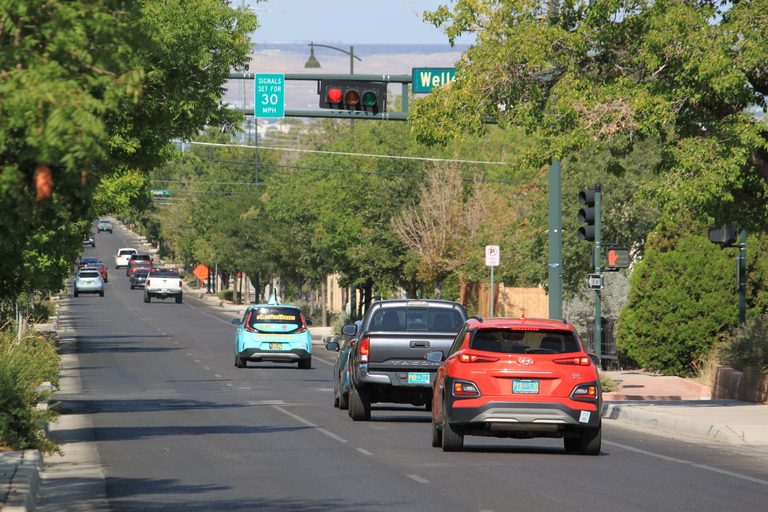
City officials in Albuquerque, New Mexico, and Portland, Oregon, are showing how technology can protect families on busy streets. By pairing the long‑standing “rest‑in‑red” traffic‑signal concept with speed sensors, the two municipalities give a green light sooner to drivers traveling at or below the posted limit, while speeders still wait for a full red cycle.
How the system works
Traditional “rest‑in‑red” signals stay red until a vehicle approaches, forcing drivers to slow down before the light changes. Albuquerque and Portland have taken the idea a step further. Sensors embedded in the roadway detect vehicle speed; if a driver is traveling at the legal limit, the signal turns green early, effectively rewarding careful driving. Speeders, however, see the light stay red longer, encouraging them to reduce speed.
Albuquerque’s early results
Jennifer Turner, director of municipal development for Albuquerque, says the technology has become its own advertisement. “If you drive the Lead and Coal avenues now, you quickly learn that speeding means you stop,” she explained. Residents like Isaac Romero, who lives along the corridor, have noticed a dramatic change. “We used to hear cars racing at night, and there were crashes that shook houses,” Romero recalled. “Now we see far fewer accidents and less damage.”
Portland’s pilot on Powell Boulevard
Portland introduced the system on Southeast Powell Boulevard during late‑night hours, a stretch with a history of serious crashes. Peter Koonce, who manages the city’s signals and street lighting, calls the approach a “virtual speed bump.” In the first test intersection, average speeds fell from 39 mph to the 30 mph limit, matching the posted speed and reducing the likelihood of high‑speed collisions.
Oregon State University researchers helped select the vehicle‑detection equipment and are now monitoring performance. David Hurwitz, a professor of transportation engineering leading the study, cautions that more data are needed. “Early signs are promising, but we must ensure the gains aren’t offset by drivers running red lights elsewhere,” he said.
Critics ask for broader education
Jay Beeber, chief government affairs officer for the National Motorists Association, acknowledges the potential of “rest‑in‑red” but warns that driver behavior may not change without a larger public‑education effort. “People might become frustrated if they don’t understand why a light stays red,” Beeber said. He suggests simpler, less‑intrusive measures could also improve safety.
Other cities watching
Albuquerque has complemented the sensor‑based lights with three speed cameras near the corridor, further reinforcing compliance. Smaller pilots are under way in Boulder, Colorado, and Long Beach, California, where the threat of additional red lights is being used to curb speeding.
Rebecca Sanders, a national safety practice leader at Fehr & Peers, notes that the strategy works best on high‑capacity roads that see lighter traffic at night—conditions that invite speeding. A 2023 study of five North Carolina roads that used a pure “rest‑in‑red” system (without speed sensors) reported a 43 % reduction in total crashes.
Looking ahead
Both Albuquerque and Portland see the technology as a tool to protect families and preserve community safety. Romero, who runs a home‑security business, believes the approach could expand citywide. “If everyone cruises at 30 mph, you get green lights all the way,” he said. “One speeder can ruin the flow for everyone, so we all have a stake in driving responsibly.”
Original reporting: NBC10 Boston — read the source article.