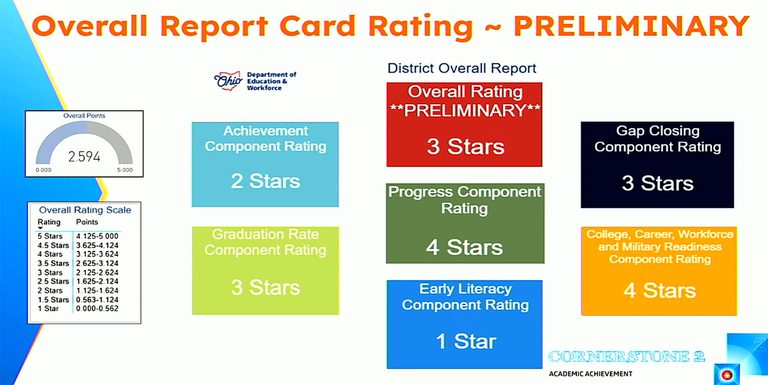
At a Tuesday school‑board meeting, Akron Public Schools learned that its preliminary report‑card rating will be three stars out of five, a half‑star drop from last year. The change stems from a new state formula that counts only third‑grade students who score high enough to be promoted to fourth grade under Ohio’s third‑grade reading guarantee.
According to the data shared with board members, about 58 percent of Akron’s third‑graders met the new benchmark. The figure does not reflect actual promotion rates—families can still move children to the next grade despite low scores, a practice that previously boosted district ratings.
Impact on the district’s rating components
The revised literacy metric left the district’s literacy component at a one‑star rating, the lowest possible score and unchanged from the prior year. Scores below three stars are considered below state standards. However, the district retained four‑star ratings in both the “progress” and “college‑and‑career readiness” categories, matching last year’s performance.
Assistant Superintendent Wanda Lash emphasized that the four‑star progress rating shows the district is “taking students where they are and growing them,” even as proficiency numbers remain a work in progress.
Graduation and achievement scores
Preliminary data also showed the district’s graduation score rose to three stars, while achievement (two stars) and gap‑closing (three stars) stayed steady from the previous report.
Full state report‑card data are expected next week.
Reading initiatives and community support
Early literacy has long been a focus for Akron schools. Director of School Improvement Keith Liechty‑Clifford noted that fewer than half of third‑graders are currently rated proficient on the state test, and that phonics‑based instruction and other supports will need a year or two to lift proficiency rates.
The district follows the Science of Reading framework and employs a structured‑literacy model that teaches students to sound out syllables, recognize spelling patterns, and connect words to meaning. Students who struggle receive multiple tutoring sessions each week, as explained by English Language Arts Supervisor Toan Dang‑Nguyen.
Akron’s partnership with the University of Akron’s Center for Structured Literacy brings college students into classrooms for intensive tutoring. The collaboration recently received a $40,000 grant from the GAR Foundation to further strengthen Science of Reading efforts.
Performance trends across grades
Four‑year trend data show mixed results. Third‑grade English Language Arts proficiency rose slightly to 47 percent for 2025‑26, up from 45.6 percent the year before, but remains below the 48.1 percent recorded in 2023‑24. As students advance, proficiency declines: only 32.6 percent of sixth‑graders scored proficient, down sharply from the 55.9 percent of fifth‑graders. Approximately one‑third of eighth‑graders and 40.2 percent of high‑schoolers met state English standards.
Math and science scores also fell for many grades, mirroring the pattern seen in English.
Looking ahead
School leaders remain optimistic that the district’s focused literacy programs, tutoring partnerships, and new grant funding will raise future proficiency rates. The upcoming full state report‑card will provide a complete picture of Akron’s academic standing.
Original reporting: Signal Akron — read the source article.