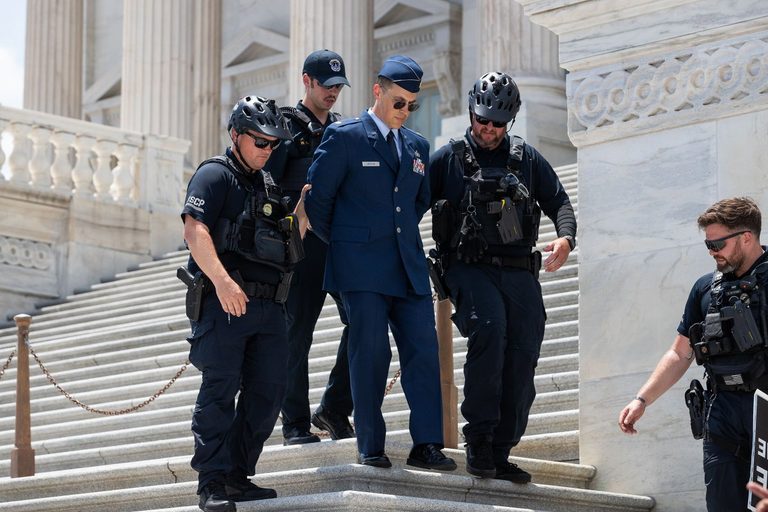
U.S. Air Force Maj. Jason Watson, the service member who was arrested on July 1 on the steps of the U.S. Capitol after delivering a speech calling for the impeachment and removal of President Donald Trump and Vice President J.D. Vance, has been ordered into pre‑trial confinement. The Air Force announced Tuesday that Watson is now being held at a county detention center in Maryland under a military hold.
Military Procedure and Charges
The Air Force spokesperson said the decision was based on “probable cause to support allegations of continued misconduct” and that Watson will be afforded all rights under Rule for Courts‑Martial 305 while his confinement is reviewed. The service member is presumed innocent until proven otherwise.
Details of the alleged misconduct have not been released. Watson’s attorney, Chris Mutimer, told CNN he has not spoken with his client since the detention and suspects the recent CNN interview may have influenced the Air Force’s action.
Recent Interview and Criticism of the President
In an exclusive interview with CNN’s Erin Burnett earlier this week, Watson reiterated his call for Trump’s impeachment, describing the president’s actions as “a failure as president, flagrantly violating the Constitution, breaking the law, engaged in rampant corruption and killing Americans.” Watson said he was prepared to “pay the price” for speaking out against the administration.
Uniform Code of Military Justice and Free Speech
Public dissent from active‑duty service members is rare because the Uniform Code of Military Justice (UCMJ) criminalizes contemptuous statements against the president, vice president, Congress and other senior officials under Article 88. The Air Force clarified that Watson’s personal statements do not reflect the views or policies of the Department of the Air Force.
When Watson was first arrested, Capitol Police noted that members of the public may not demonstrate on the House steps unless escorted by a member of Congress. Watson was escorted to the steps by a member of Congress who then left the area. He wore his uniform during the demonstration, which is prohibited by military regulation for political activities, though no specific uniform‑violation charge has been filed.
Legal Context and Next Steps
Watson’s pre‑trial confinement means he will remain in the Maryland facility while the Air Force conducts a review of the allegations. If the case proceeds, it could be tried under a court‑martial, where Watson would have the right to counsel, to present evidence, and to appeal any conviction.
The situation underscores the tension between a service member’s right to free expression and the military’s requirement for discipline and obedience to the chain of command. While the First Amendment protects speech, the UCMJ imposes additional limits on active‑duty personnel, especially when statements target the nation’s highest officials.
Public Reaction
The incident has drawn attention from both supporters of Watson, who view his detention as a suppression of dissent, and critics who argue that military personnel must adhere to strict standards of conduct. No official statements have been released from the White House or the Department of Defense beyond the Air Force’s standard remarks.
As the review continues, Watson’s case will likely be watched closely by civil‑rights groups, military legal experts, and those concerned about the balance between constitutional freedoms and military order.
Original reporting: KTVZ (Central Oregon) — read the source article.