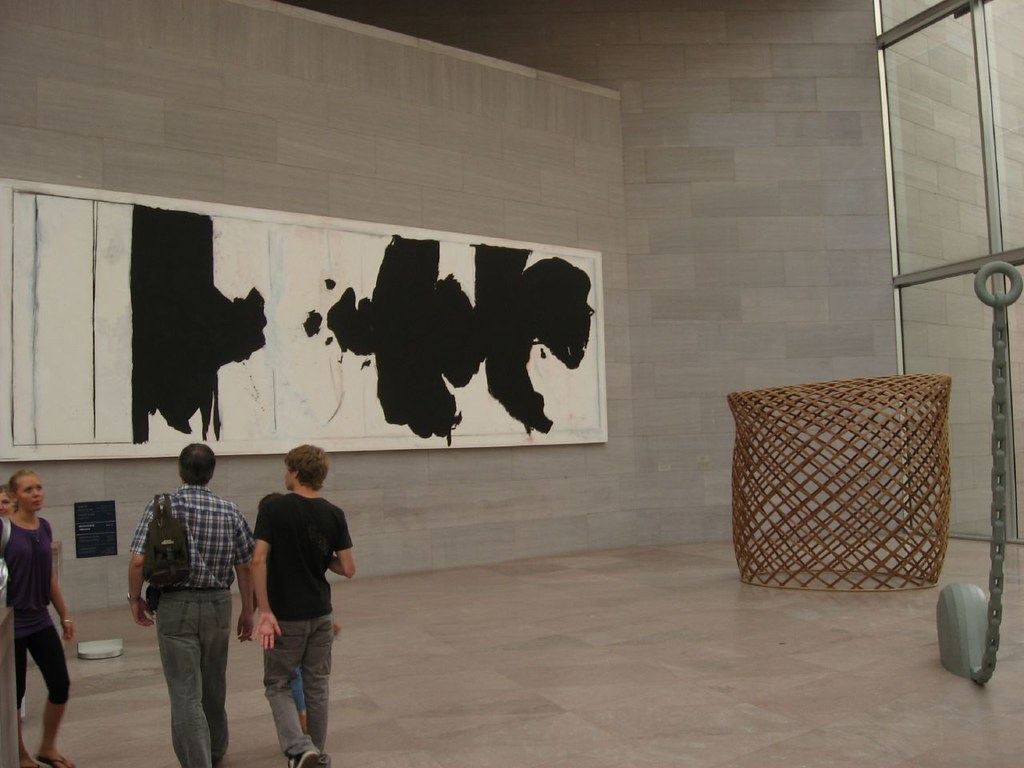
On a weekday afternoon in late spring, the East Building’s central atrium fills with a particular quality of light — filtered through the skylights above, pooling on the pale travertine floors, catching the edge of Alexander Calder’s massive red-and-black mobile as it barely, imperceptibly turns. Most visitors stop, look up, and stand still for a moment longer than they planned. That’s the building working on you.
The East Building sits on the Mall between the Capitol and the Washington Monument, connected underground to the older West Building but architecturally its own world. I.M. Pei designed it in 1978, and the structure itself — all acute angles and knife-sharp corners — remains one of the more quietly radical buildings in the city. The acute corner on the Pennsylvania Avenue side has been touched by so many hands over the decades that the marble there is noticeably worn, darkened by contact. A small brass plaque explains it. Worth finding.
Inside, the permanent collection skews heavily toward 20th-century modernism. There are significant holdings of Matisse, including a large-scale cut-paper composition that rewards time. Mark Rothko’s color field paintings occupy their own room, and the museum’s lighting is calibrated to show them without glare. Joan Miró, Pablo Picasso, and a strong collection of American abstraction round out the permanent floors. None of it feels crowded or rushed — the galleries are large, the benches are real benches, and the staff mostly leave visitors alone.
The East Building also runs serious temporary exhibitions. These draw lines on weekends, especially during blockbuster runs, but weekday mornings before noon are usually manageable. Tickets to special exhibitions run roughly $12–$22 depending on the show; permanent collection admission is free, as it is across all Smithsonian and National Gallery spaces.
The lower level connects to the West Building through a moving walkway lined with light sculpture — a little dated now, but kids still find it strange and wonderful — and opens into the West Building’s Dutch Masters and Renaissance galleries, which feel like a completely different country. The tonal shift is abrupt and deliberate. A full day here is easy to lose.
For food, the Cascade Café in the underground concourse is functional and reasonably priced for a museum cafeteria — sandwiches, salads, hot entrées, decent coffee. It gets crowded at midday. The Garden Café in the West Building is quieter and slightly more polished. Neither will be the best meal in Washington, but both are better than leaving and losing your bearings.
The East Building is at 4th Street and Pennsylvania Avenue NW, easily reachable from Archives-Navy Memorial station on the Yellow and Green lines. It opens at 10 a.m. most days and closes at 5 p.m., with extended Friday hours in some seasons. The permanent collection requires no advance planning — walk in, take the escalator up, and find the Calder. Everything else will follow from there.