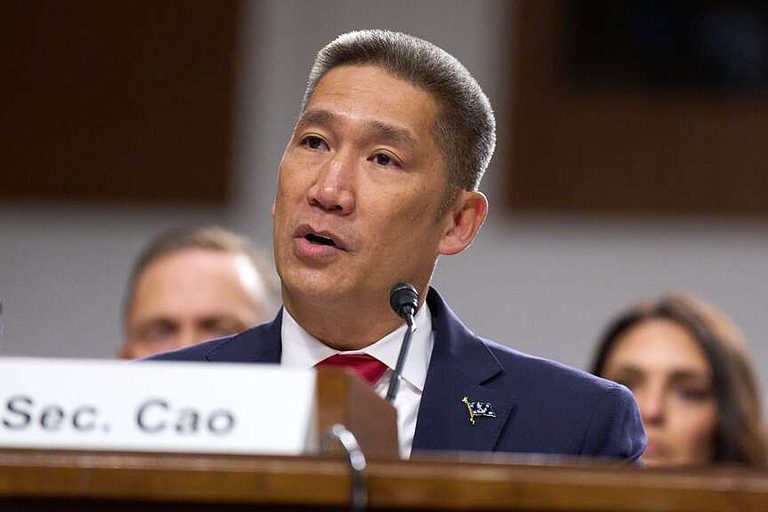
Texarkana – In a high‑profile Senate Armed Services Committee hearing, Acting Navy Secretary Hung Cao, a Trump‑appointed combat veteran, addressed concerns about the ongoing Iran conflict and its impact on the U.S. Navy. Cao stressed that, despite the operational strain, the war is delivering a strategic advantage by forcing China to reconsider its regional ambitions.
Strategic benefit amid resource challenges
“This war, again, I know it’s a strain on our Navy,” Cao told senators, but he quickly added that “it’s really set China back on their heels” as all services work together. The administration’s view is that the Iran blockade, while costly, is a necessary pressure point that limits Tehran’s ability to fund hostile actions and simultaneously signals to Beijing that U.S. resolve remains strong.
Cost concerns and congressional oversight
Sen. Elizabeth Warren (D‑Mass.) pressed Cao on the reported $32.5 million‑a‑day cost of the naval blockade and the $400 million damage to the Navy’s regional headquarters in Bahrain. Cao confirmed the blockade figure but noted that a full damage assessment was unavailable because the area is “non‑permissive” for U.S. personnel. He reiterated that the administration remains committed to transparency while protecting operational security.
Supporting sailors and families
Lawmakers raised alarms about living conditions aboard deployed ships, citing reports of food shortages and weight loss among crew members. Cao responded that the Navy is focused on sailor welfare, likening the situation to “my kids opening the refrigerator door and saying there’s nothing to eat in here.” He promised accelerated supply chains and highlighted ongoing mental‑health resources to address the reported suicide attempts, describing them as “mitigations” that the Navy is actively working to prevent.
Boosting munitions production
Republican senators Deb Fischer (R‑Neb.) and Joni Ernst (R‑Iowa) expressed concern over dwindling stockpiles of Tomahawk cruise missiles and air‑defense interceptors. Cao reported a significant increase in production, noting that while the Navy once produced about 125 Tomahawks per year, it now manufactures “well above 60 every month.” He also mentioned efforts to ramp up interceptor output to sustain the fleet’s defensive capabilities.
Addressing expired munitions
When questioned about the use of expired munitions, Cao admitted the Navy has been “recoding” certain weapons to extend their service life, comparing the process to adding water to stale bread before microwaving it. He emphasized that safety remains paramount and that the Navy is pursuing new contracts to replace aging stock.
Maintaining civilian control
Cao’s nomination requires a congressional waiver because he left active duty in 2021, less than the seven‑year cooling‑off period mandated for civilian secretaries. The administration argues that his combat experience and proven loyalty to President Trump make him uniquely qualified to lead the Navy during this volatile period.
Looking ahead
The hearing underscored the delicate balance between sustaining a demanding overseas operation and preserving the welfare of service members. Cao’s testimony highlighted the Trump administration’s commitment to a strong, resilient Navy that can confront both the Iran conflict and the broader strategic challenge posed by China.
Original reporting: Texarkana Gazette — read the source article.