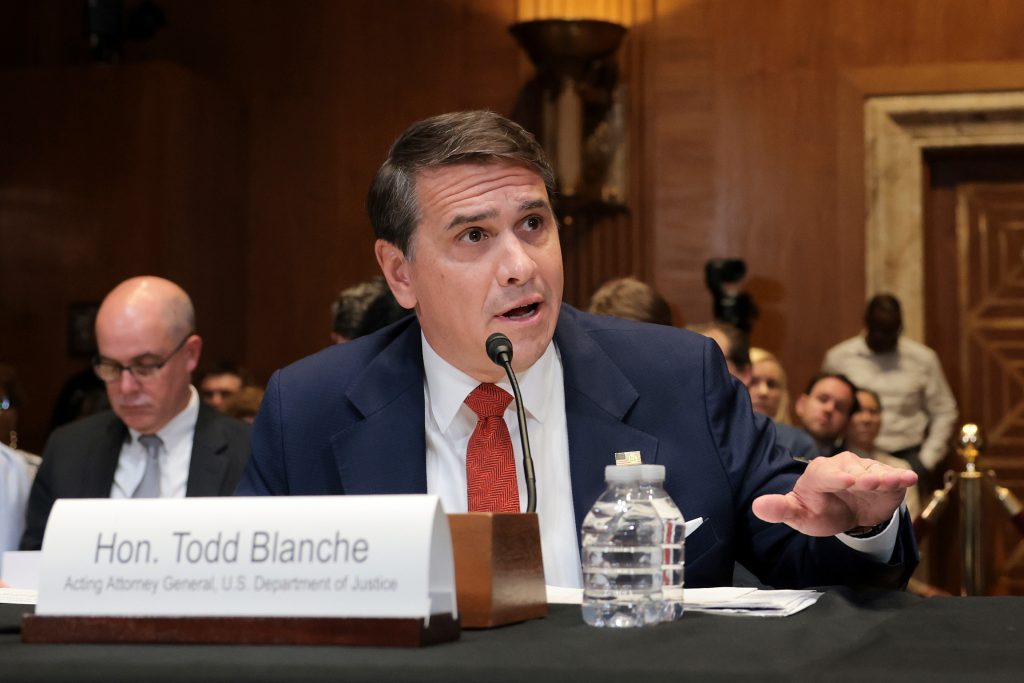
Acting Attorney General Todd Blanche faced sharp questioning in Washington as he defended the new $1.776 billion “Anti-Weaponization Fund” and declined to rule out payouts to people who say they were targeted politically — even those tied to the Jan. 6, 2021 riot at the U.S. Capitol. Senators pressed Blanche about who will decide eligibility, how the five-member commission he appoints will operate, and whether violence or convictions will automatically disqualify applicants. The hearing touched on broader Republican claims that prior administrations weaponized the Justice Department, while Democrats warned the fund could reward criminal behavior. Key figures named included Sen. Jeff Merkley, Sen. Chris Van Hollen, Sen. John Thune, Sen. Bill Cassidy, President Joe Biden, Hunter Biden, Merrick Garland, Pam Bondi and former President Donald Trump.
The tone in the room was tense but predictable: Republicans framed the fund as a necessary corrective to politicized prosecutions, while Democrats called it a misuse of public money. Blanche, who only recently took charge of the Justice Department, told lawmakers the fund was “unusual” but not unprecedented and emphasized that anyone who believes they were treated unfairly could apply. He stressed that the payouts would be decided by a commission, and he defended his role in appointing commissioners who will set the rules.
When Sen. Jeff Merkley pressed Blanche about people who assaulted police on Jan. 6 being eligible, Blanche said all people can apply if “they believe they were a victim of weaponization.” He declined to say whether he would tell commissioners to bar those convicted of violence, instead promising oversight of the panel. Blanche added, “What I will commit to is making sure that the commissioners are effectively doing their jobs, and that includes setting guidelines as you’re describing,” making his point that he expects the commission to shape the process.
Blanche also made clear the fund’s reach is broad, noting it won’t be directed only at one political party or a single event. “It’s not limited to Republicans. It’s not limited to Democrats. It’s not limited to January 6th defendants. It’s limited only by the term weaponization,” he said, and even suggested that high-profile figures like Hunter Biden could technically apply. That line drew immediate criticism from Democrats who see the move as a partisan maneuver aimed at Mr. Trump’s allies.
Democratic members of the committee reacted with alarm, painting the fund as a direct payoff to political allies and a Trojan horse for retribution. “Rewarding individuals who committed crimes is obscene,” Sen. Chris Van Hollen said. “Every American can see through this illegal, corrupt, self-dealing scheme,” he added, hammering the theme that taxpayer money should not be used to reward criminal acts.
Republican supporters argued the fund answers a real problem: when law enforcement or prosecutors cross the line and political pressure taints justice. Blanche’s moves since taking over the department — from advancing certain prosecutions to pursuing leak investigations and setting up the fund tied to a lawsuit against the IRS — were cast by allies as necessary corrections. They insist accountability matters whether the targets are on the left or the right.
There was, however, some unease within Republican ranks. Senate Majority Leader John Thune said he’s “not a big fan,” questioning the purpose of the fund even as he stopped short of outright condemnation. Louisiana Sen. Bill Cassidy dismissed it as a “slush fund,” showing that concerns about optics and precedent cut across party lines in the Senate.
Blanche’s defenders point out a practical reality: the federal judgment fund is already used to pay legal settlements and judgments, and this mechanism would simply provide a vehicle for resolving politically charged claims without clogging courts. Critics see the same mechanism as a backdoor to funnel taxpayer dollars to political allies, especially after pardons and commutations tied to Jan. 6 participants and personnel changes that followed prosecutions.
The hearing also included stark exchanges about the meaning of “weaponization,” with Blanche promising transparency on beneficiaries but offering little detail on how that term will be defined. He said he “will definitely encourage the commission” responsible for deciding on the payouts to “take everything into account,” which leaves a lot of discretion to the panel he appoints. Opponents worry that broad discretion plus political appointments equals politicized payouts.
Tensions between past and present Justice Department approaches came up repeatedly, with references to Merrick Garland’s tenure and the assertion from Republicans that prosecutions under prior leadership had political overtones. Blanche and his allies portrayed the fund as a tool to restore fairness and deter future misuse of federal power, while Democrats countered that it mirrors the very politicization they accuse the current administration of practicing. The debate is far from settled as Congress and the Justice Department sort out how the fund will operate.