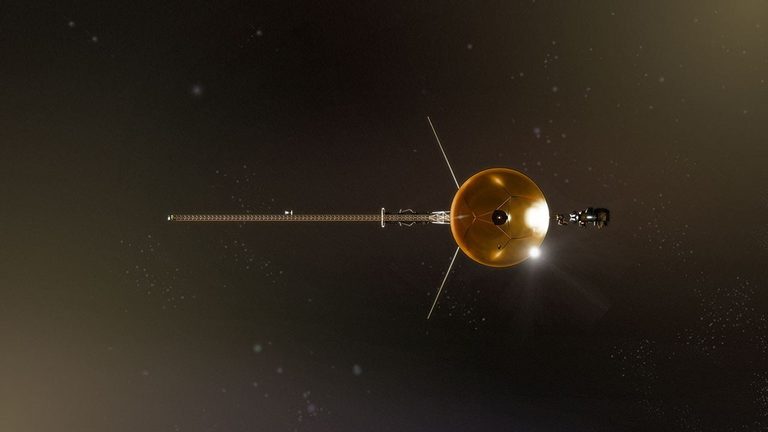
TOLEDO, Ohio – NASA’s historic Voyager 1 probe has achieved a new milestone: it is now a full light‑day away from Earth. That means a command sent from the Deep Space Network takes 24 hours to reach the spacecraft, and its scientific data takes another 24 hours to travel back.
Mission background and current status
Launched on Sept. 5, 1977, Voyager 1 was originally slated for a five‑year mission to explore the outer planets. Thanks to a rare alignment of the four gas giants that occurs only once every 175 years, the probe used gravity‑assist slingshots to reach the far reaches of the solar system and beyond.
During its early years Voyager 1 sent iconic images, including the famous “pale blue dot” taken in 1990 that shows Earth from beyond Neptune’s orbit. Its cameras have since been turned off to conserve power, but the remaining instruments continue to measure magnetic fields and charged particles in interstellar space.
Scientific value of the interstellar measurements
“Scientists before Voyager 1 broke the heliosphere had only models of the interstellar medium,” said Jennifer Rocca, Deputy Division Manager of Astrophysics and Heliophysics Flight Projects at NASA’s Jet Propulsion Laboratory. “Voyager’s direct measurements give humanity our first real data on what the interstellar medium looks like.”
Since entering interstellar space in August 2012, Voyager 1 has provided continuous data on the magnetic environment beyond the Sun’s protective bubble, helping researchers refine theories about cosmic radiation and the structure of our galaxy.
Power constraints and future outlook
Voyager 1 is powered by a radio‑isotope thermoelectric generator whose output is slowly declining. All but two of its instruments have been shut down to stretch the remaining energy. NASA estimates the probe has only a few years of power left, with an expected silence sometime in the 2030s.
Even after its power fades, the spacecraft will keep coasting through interstellar space. It also carries a 12‑inch gold‑plated copper “Golden Record” that contains sounds, music, and greetings from Earth, intended as a time capsule for any future discoverers.
Why the achievement matters
The one‑light‑day distance underscores how far humanity’s reach has extended. It also highlights the durability of engineering and the value of long‑term scientific investment. As Rocca noted, the Golden Record represents a “civilization‑level effort” that showcases the United States’ leadership in space exploration and the collaborative spirit of people worldwide.
Voyager 1’s continued operation serves as a reminder that even decades‑old missions can still contribute valuable knowledge, reinforcing the importance of supporting NASA’s long‑range projects for future generations.
Original reporting: 13abc WTVG Toledo (news) — read the source article.