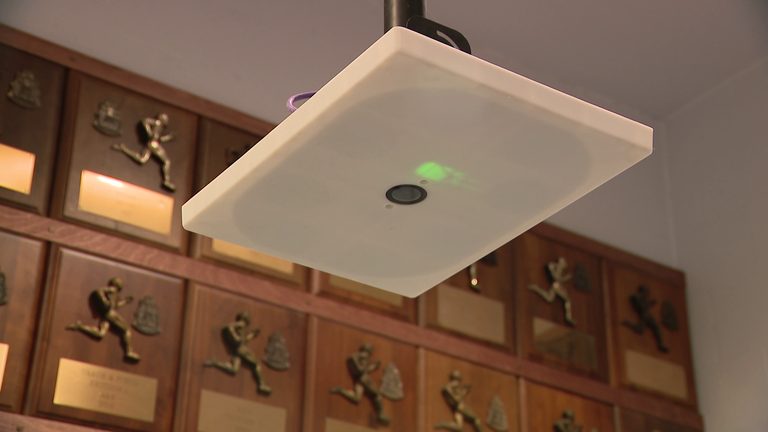
Hempfield Area High School in Westmoreland County has deactivated its artificial‑intelligence weapons detection system after nearly a year of data collection showed the technology was not ready for everyday use. Superintendent Dr. Mark Holtzman said the pilot, which relied on Wi‑Fi frequencies to spot potential threats at school entrances, produced far too many false alarms.
Testing revealed persistent false positives
The system, known as Wi‑AI, was part of a statewide pilot involving several schools. Its goal was to identify weapons by detecting shapes on people as they passed under ceiling‑mounted pods. Over the past school year, the pods gathered data from students, staff, and visitors, but the technology repeatedly confused ordinary items—binders, metal water bottles, battery packs—with weapons.
“It’s a little bit of a bummer that we’re not at the cutting edge right now,” Holtzman said. “From binders to metal water bottles to the battery packs, you name it, kids have gadgets. That’s more of the problem. It’s the false positives. It’s not the detection of anything. It’s just not a product that’s ready for activation.”
Performance far below expectations
Developers had hoped the model could achieve a 95% efficiency rate before being rolled out as the primary security system. Holtzman confirmed the system fell well short of that benchmark. “It’s not near 95%, I could tell you that much,” he said.
Company response
Skip Smith, co‑founder and CEO of Curvepoint AI, the firm behind the detector, issued a statement to Pittsburgh’s Action News 4. He clarified that Hempfield served only as a testing and evaluation site, not an operational deployment. “We’ve conducted several rounds of testing and collected data on system throughput and weapons‑detection performance,” Smith wrote. “The most important conclusion is that we did not believe the technology demonstrated the consistency and reliability necessary for operational deployment. We’re continuing to develop and evaluate the technology, but we are not currently supporting operational deployments, and we don’t have a deployment date to announce.”
Financial and operational implications
The school district used general funds to purchase the detectors, but because the program never moved beyond testing, the district expects to recover those costs. “We didn’t meet the threshold of the actual contract agreement,” Holtzman explained. “It was just a great opportunity without having to contribute any dollars or have any taxpayer dollars spent.”
Return to proven security measures
Hempfield will continue using its existing OpenGate metal‑detector system, which has been in place for years. “We’re very happy and secure with Open Gate. Maybe that’s going to be the future and continue to be the future,” Holtzman said. “Whatever it is we’re going to do, we’re going to stay on the cutting edge.”
While Curvepoint AI has not set a timeline for an improved model, Holtzman expressed openness to future collaboration. “We’re going to continue to offer support. If they need to use our facility to help train, we’re open to that conversation. We have a great relationship with our folks at Curvepoint. I’m still optimistic about where it might head down the road,” he added.
What this means for local schools
The episode underscores the challenges of adopting emerging technologies in school safety without thorough real‑world validation. Parents and community members can take comfort that the district is reverting to a proven security system while continuing to explore innovative solutions that meet rigorous reliability standards.
Original reporting: WTAE (Hearst) – local — read the source article.