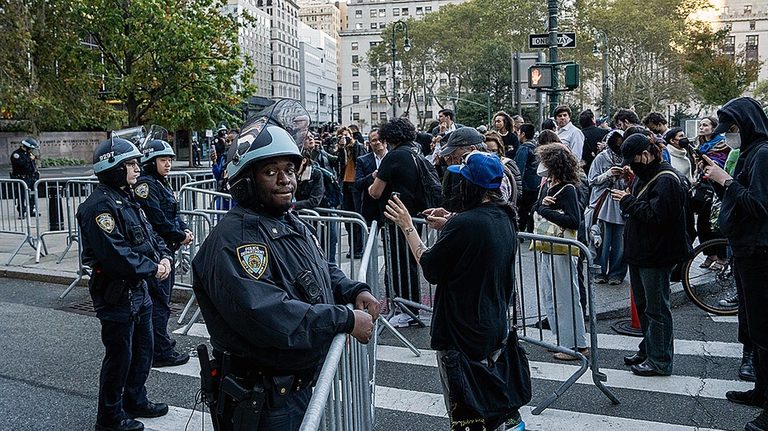
New York City Mayor Zohran Mamdani announced on Monday that the NYPD’s Strategic Response Group (SRG) will be disbanded. In its place, the city is creating a civilian‑led approach to protest response, overseen by the newly formed Community Dialogue and De‑escalation Division (CDDD) within the Mayor’s Office of Community Safety.
New structure for protest response
The CDDD will coordinate a specialized “First Amendment Support Team” (FAST) composed of 30 uniformed officers trained in communication and de‑escalation. FAST officers will have no weapons or arrest powers, focusing instead on dialogue with demonstrators. In addition, the NYPD will establish a Patrol Support Division (PSD) inside the Patrol Services Bureau. PSD officers will spend the majority of their time on routine patrol duties and receive specialized crowd‑management training to support demonstrations when needed.
Mayor’s promise fulfilled
During his campaign, Mamdani pledged to separate counter‑terrorism duties from protest response and to eliminate the SRG’s role in peaceful demonstrations. “New Yorkers exercising their constitutional right to protest should not be met with the same police response as a terrorism threat,” Mamdani said in a statement. “We are establishing a new, civilian‑led approach that prioritizes dialogue, engagement and de‑escalation.”
Restrictions on protest‑control tools
The reforms also codify new limits on the equipment police may use during demonstrations. The city will ban kettling, prohibit the use of long guns and tear gas, and restrict pepper spray as a crowd‑management tool. Long‑range acoustic devices will be limited to a maximum output of 90 decibels.
Background on the SRG
Under the previous structure, the SRG was described by the NYPD as a “critical asset” for citywide mobilizations, civil disorders, major events, and even the papal visit. SRG personnel were also deployed to areas with heightened crime or other conditions, handling shootings, bank robberies, missing‑person cases, and other significant incidents.
Police Commissioner Jessica Tisch noted at a March budget hearing that the SRG typically did not handle peaceful protests, but was called in when protests involved criminal activity. In 2025, the NYPD facilitated 4,255 protests, and the SRG was present at 245 of them—roughly six percent of total demonstrations.
Community reaction
Local advocacy groups and neighborhood associations have welcomed the shift toward a dialogue‑focused model, emphasizing that it aligns with constitutional protections for free speech and assembly. Critics, however, caution that the city must ensure the new units receive adequate resources and training to handle large‑scale events safely.
The mayor’s office indicated that the CDDD will work closely with community leaders, faith‑based organizations, and local businesses to build trust and foster constructive communication during protests. By placing emphasis on de‑escalation rather than force, the administration hopes to reduce tensions and protect both public safety and First Amendment rights.
Next steps
Implementation of the new divisions will begin immediately, with FAST officers receiving intensive training over the next several weeks. The NYPD plans to roll out the revised crowd‑management protocols citywide by the end of the year, ahead of upcoming public‑safety events and the city’s 2027 budget cycle.
Original reporting: Fox News (HLL/CB) — read the source article.