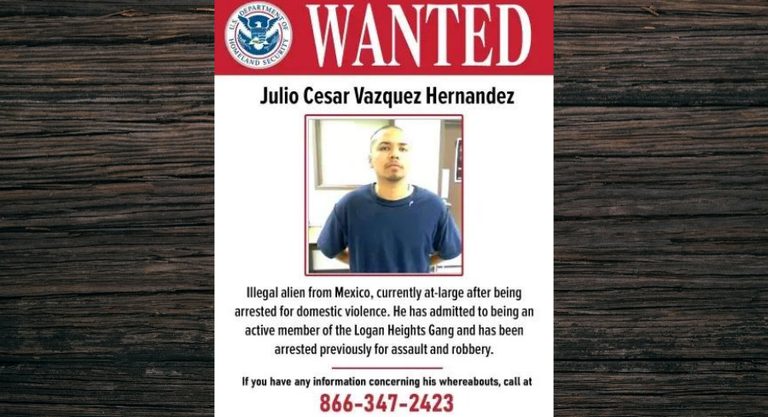
Federal officials on Friday sharply criticized San Diego County Sheriff’s Office for releasing a Mexican national who federal authorities say is an active member of the Logan Heights gang. The Department of Homeland Security (DHS) said the decision violates public‑safety interests and highlights the dangers of California’s sanctuary policies.
Federal response
Homeland Security Secretary Markwayne Mullin issued a statement calling the release “reckless” and accusing sanctuary politicians of endangering their constituents by freeing illegal aliens with violent criminal histories. Mullin noted that the detainee, Julio Cesar Vazquez Hernandez, was arrested on November 5 on domestic‑violence charges and a restraining‑order violation. ICE subsequently lodged an immigration detainer requesting that local officials hold him pending removal.
Despite the request, San Diego jail officials declined to honor the detainer and released Hernandez, who remains at large. Mullin said, “If sanctuary politicians put an end to these heartless policies and started working with us, we could make their communities safe again.” He added that seven of the ten safest cities in the nation cooperate fully with ICE.
Hernandez’s criminal background
DHS described Hernandez as having entered the United States illegally at an unknown date and location. His record includes a conviction for driving under the influence, as well as prior arrests for robbery, theft, assault with a deadly weapon, and participation in a criminal street gang. Federal officials argue that releasing such an individual poses a clear threat to public safety.
California’s sanctuary framework
The release occurred under California’s Senate Bill 54, which limits local law‑enforcement agencies from holding individuals solely on civil immigration detainers unless the person has been convicted of certain serious or violent felonies. State officials and the San Diego County Sheriff’s Office have not responded to DHS’s statement.
DHS cited more than a dozen similar cases in California over the past two years involving undocumented immigrants arrested or convicted of violent crimes, fatal drunk‑driving crashes, and drug trafficking. The department also referenced out‑of‑state incidents, including fatal commercial‑truck crashes in Ohio, Oregon and Florida, and a murder suspect in Utah who was previously released from California jails despite ICE detainers.
Broader implications
The controversy underscores the ongoing clash between federal immigration enforcement and state sanctuary laws. Federal officials argue that non‑cooperation hampers efforts to protect communities, while California officials maintain that SB 54 protects constitutional rights and prevents local resources from being used for civil immigration matters.
Advocates of sanctuary policies contend that cooperation with ICE can erode trust between immigrant communities and law‑enforcement, making it harder to solve crimes. Critics, like Secretary Mullin, argue that public safety is compromised when dangerous individuals are released.
What’s next?
Federal authorities have indicated they will continue to monitor compliance with ICE detainers and may pursue legal avenues to enforce cooperation. Meanwhile, California lawmakers are expected to defend the sanctuary framework, emphasizing state authority and constitutional protections.
Residents of San Diego and the broader state will be watching closely as the debate over immigration enforcement and public safety unfolds.
Original reporting: Tampa Free Press — read the source article.