With the Dec. 11 deadline for the federal budget fast approaching, Congress is wrestling with a partisan showdown over President Trump’s ongoing military operation against Iran. The dispute centers on whether future appropriations should be conditioned on limiting the administration’s ability to fund the operation, a move championed by several Democrats that could trigger a shutdown.
Republican defense of presidential authority
Republican Representative Robert Aderholt of Alabama warned that curbing the president’s war powers could be far more dangerous than a temporary shutdown. “If they get nuclear weapons, you won’t be worrying about a shutdown,” Aderholt told Hearst Television, emphasizing that the United States must retain the flexibility to respond to any nuclear threat posed by Iran.
Aderholt stressed that he is not advocating for a shutdown, but he believes that restricting the president’s authority in a nuclear context would jeopardize national security. This stance reflects the broader Republican view that the executive branch must retain decisive control over military matters, especially when American lives and global stability are at stake.
Democratic push for funding restrictions
On the other side, a coalition of Democratic senators—including Michael Bennet of Colorado, Tammy Duckworth of Illinois, Chris Van Hollen of Maryland, and independent Senator Bernie Sanders of Vermont—issued a joint statement demanding that any short‑term spending bill include language barring the use of federal funds for continued combat operations in Iran.
Representatives Ro Khanna of California and Tim Kaine of Virginia have echoed these calls, urging Congress to attach strict conditions to any appropriations that would fund the Iran operation. They argue that continued financing without oversight risks further entanglement in a costly overseas conflict.
Leadership’s cautious approach
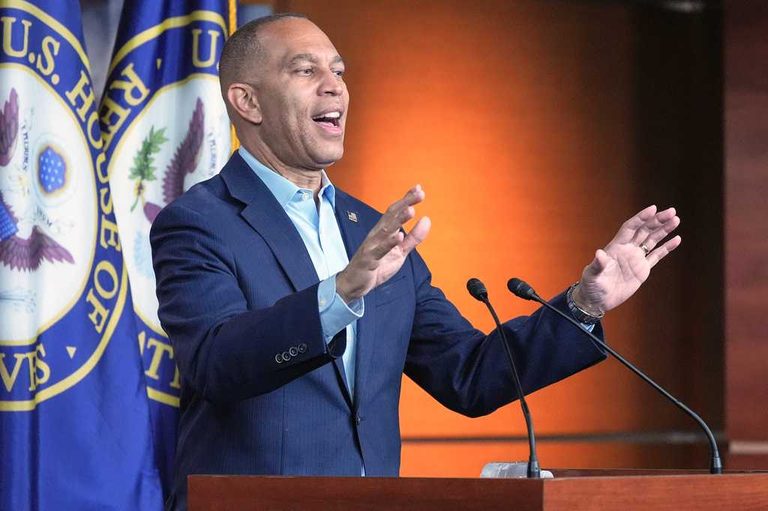
House Democratic Leader Hakeem Jeffries acknowledged ongoing “four‑corners negotiations” led by Appropriations Committee Chair Rosa DeLauro of Connecticut. While Jeffries reiterated the party’s opposition to additional war funding, he also noted that Democratic leadership has not yet made the funding restrictions a non‑negotiable condition for keeping the government open.
“House Democrats have uniformly opposed providing any additional money to President Trump’s war machine over in the Middle East,” Jeffries said, underscoring the party’s consistent stance against expanding the war effort.
Incoming members weigh in
Newly elected representatives are also weighing in. Representative‑elect Dan Koh of Massachusetts told Hearst Television that ending the war is a priority, even if it means risking a shutdown. When asked if the risk was worth it, Koh answered unequivocally, “Absolutely.” Similarly, Representative‑elect Jacqui Irwin of California called for “every bit of leverage” to stop what she described as “a war of choice.” Both will assume office in January, after the funding deadline.
Potential impact of a shutdown
Should a shutdown occur, federal workers could face furloughs or delayed pay, and essential services such as air travel and certain food‑assistance programs could be disrupted. The last shutdown, which lasted 43 days, caused widespread inconvenience and highlighted the real costs of political stalemate.
Lawmakers on both sides recognize the stakes, but the fundamental disagreement remains: whether to prioritize unfettered presidential authority to confront a perceived nuclear threat, or to impose congressional checks on funding for a foreign operation that many view as unnecessary.
What’s next?
As the deadline nears, the House and Senate will continue negotiations. Republicans are likely to argue that any restriction undermines national security, while Democrats will push for stricter oversight to prevent further escalation. The outcome will determine whether the nation faces a shutdown or proceeds with continued funding for the Iran operation.
Original reporting: 40/29 / KHBS (NW Arkansas) — read the source article.