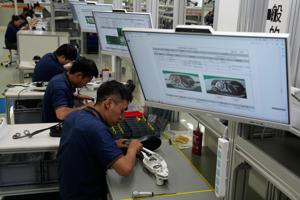
China is making significant strides in the production of humanoid robots, with companies like Matrix Robotics and EngineAI leading the charge. These robots, capable of performing tasks such as directing traffic and making coffee, are being developed to address challenges like an aging population and rising labor costs.
Production vs. Demand
Despite the ability to produce these robots at scale, demand remains a concern. Experts suggest that the current use cases for humanoid robots are limited, often more performative than functional. Samm Sacks, a senior fellow at the New America think tank, highlights the challenges faced by these robots in unpredictable environments.
Matrix Robotics, based in Shanghai, has received around 1,000 orders for its MATRIX-3 humanoid robot, priced at approximately $99,000. Meanwhile, EngineAI’s robots, costing 180,000 yuan ($26,600), are being marketed for roles such as security guards and museum guides. However, the real-world application of these robots is still in its infancy, with many factories already equipped with non-humanoid robotic arms for repetitive tasks.
Market Dynamics
The Chinese government has expressed concerns about a potential bubble in the humanoid robot industry due to the slow pace of commercialization. Despite this, state-owned enterprises continue to place orders, accounting for a significant portion of the market.
China’s dominance in the global humanoid robot market is evident, with Chinese companies accounting for 85% of the market share last year. The country’s five-year plan emphasizes advancements in technology, including humanoid robots, which has provided substantial state support to startups in this sector.
Challenges Ahead
While production capabilities are impressive, the cost of humanoid robots remains a barrier to widespread adoption. Reports suggest that although Chinese robots are cheaper than their foreign counterparts, they are still too expensive for mass deployment. Additionally, the need for extensive data to train these robots for complex tasks presents another hurdle.
As the technology matures, there is potential for humanoid robots to take on roles in industrial and logistics settings, performing tasks that are dangerous or repetitive. However, achieving the level of functionality required for household use, such as elderly or child care, remains a distant goal.
Original reporting: KTBS 3 (Shreveport) — read the source article.