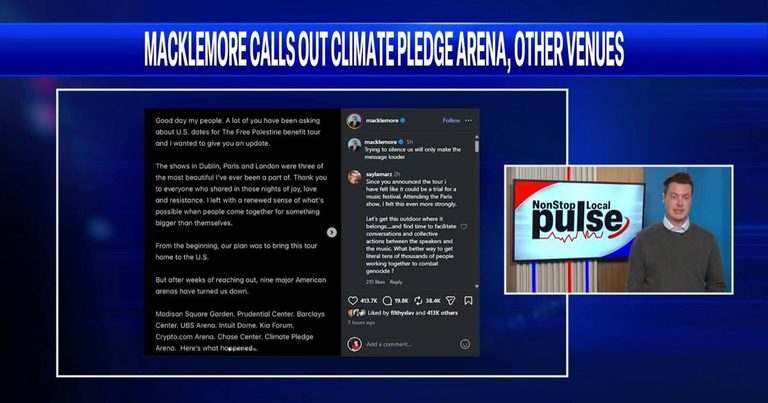
Seattle native Macklemore used his Instagram platform on Monday to share that Climate Pledge Arena, the city’s premier indoor venue, declined to host his planned “Free Palestine Tour.” The rapper, whose real name is Ben Haggerty, said the arena’s decision was part of a broader pattern, noting that nine other major American venues also refused to book dates for the tour.
Tour origins and recent setbacks
The tour was first announced after Macklemore was removed from Ed Sheeran’s tour earlier this year. He was taken off the lineup following comments he made on stage in support of Palestine, comments that sparked controversy among concert promoters and venue operators.
In his Instagram caption, Macklemore wrote, “Tried to bring the Free Palestine Tour to Seattle’s Climate Pledge Arena and got a no. Also heard nine other big venues say the same. Looks like the message isn’t getting the stage space it deserves.” He did not provide further details about why the arena declined, nor did he receive a response from Climate Pledge Arena when the outlet reached out via social media.
Venue perspective
Climate Pledge Arena, owned by the Seattle Kraken and the Seattle Storm, has positioned itself as a leader in sustainable event hosting. The arena has not publicly commented on Macklemore’s claim, and its management has not issued a statement regarding the specific tour request.
Industry observers note that venues often weigh a variety of factors when scheduling concerts, including artist safety, audience demand, and potential public backlash. While no official reason has been given, the arena’s silence leaves room for speculation.
Broader context of concert bookings and political expression
Concert promoters and venue operators across the United States have faced increasing pressure when artists incorporate political messages into their performances. Some venues have opted to avoid potential controversy by declining bookings that could spark public protests or media scrutiny.
Critics of such decisions argue that limiting stage access for politically charged performances infringes on free expression, while supporters contend that venues have a right to curate programming that aligns with community standards and business interests.
Community reaction
Seattle residents and fans of Macklemore have expressed mixed reactions on social media. Some praised the rapper for speaking out, while others questioned whether the tour’s political focus might alienate certain audience members.
Local advocacy groups have not yet issued formal statements, but the episode adds to ongoing national conversations about how cultural institutions respond to artists who address contentious geopolitical issues.
What’s next for the tour?
Macklemore indicated that he will continue seeking venues willing to host the Free Palestine Tour, though he did not specify alternative locations or dates. He thanked his followers for their support and urged them to stay engaged with the cause.
As the story develops, both the artist and the venues involved may provide further clarification, shedding light on the balance between artistic freedom and venue policy in today’s polarized cultural climate.
Original reporting: KHQ Spokane (news) — read the source article.