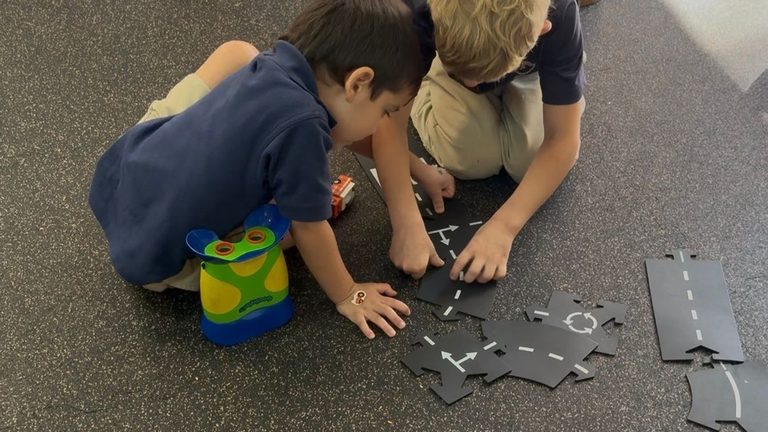
Little Rock, Ark. – Pulaski Academy has taken a decisive step to curb screen time for its youngest learners. In preschool and kindergarten classrooms the school now relies on hands‑on projects, robotics and collaborative play instead of tablets and computers.
Teachers cite research and observable gains
“I want them to feel like they’re at a children’s museum where they’re just playing,” said Juli Paddie, the school’s STEAM teacher. Paddie explained that the decision was guided by a recent book study on brain development and screen exposure, which suggested that excessive digital use can alter children’s neural pathways in ways that are not always beneficial.
Head of the Early Childhood School, Tiffany Knight, echoed the sentiment, noting measurable improvements since the policy shift. “We see an improvement in fine motor skills and in their thoughts and vocabulary because they’re dialoguing with each other as they’re building,” she said.
Robotics replace tablets
While the academy still embraces technology as a core component of STEAM (science, technology, engineering, art and math), it delivers that instruction through physical devices. Students work with B‑Bots and other programmable robots that respond to color or directional cues, allowing them to practice sequencing and problem‑solving directly on the device without a screen.
“We do realize technology is part of STEAM,” Knight said. “However, we want to make sure that they’re not doing it through an iPad or a computer.” Paddie added, “We have robots that code by color, and robots that code by directional cues, and you do it directly on that device, so we don’t have to have the accompanying tablet.”
Parents and community respond positively
Parents surveyed after the change reported that their children appear more engaged during class activities and are eager to discuss what they built. Many expressed relief that the school is taking a proactive stance on a topic that has sparked national debate about children’s screen exposure.
Local education advocates praised Pulaski Academy’s approach as a model for other schools seeking to balance technology with tactile learning. “When kids manipulate real objects, they develop the kind of spatial reasoning and social interaction that screens can’t replicate,” said a representative from the Arkansas Association of Private Schools.
Looking ahead
Pulaski Academy plans to continue monitoring student outcomes, using both teacher observations and standardized assessments to gauge the long‑term impact of reduced screen time. The school hopes its model will inspire broader conversations about how best to integrate technology into early‑childhood education while preserving the developmental benefits of hands‑on learning.
Original reporting: KATV Little Rock (local) — read the source article.