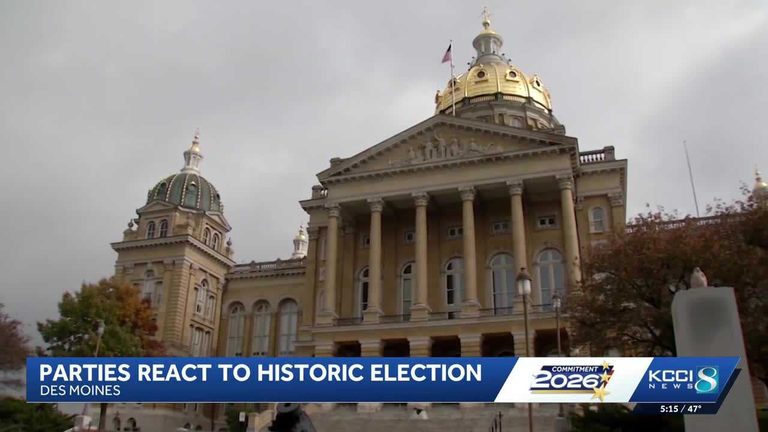
In Tuesday’s 2026 midterm elections Iowa voters kept the Republican Party in control of both chambers of the state legislature, but the margins of that control have narrowed significantly. The Iowa Senate now stands at a 32‑17 Republican majority with one vacancy, a drop from the supermajority the GOP enjoyed after the 2024 election.
Key Senate races
Democrats captured two Senate seats in special elections. In District 1, Democrat Catelin Drey (Sioux City) won a September 2025 special election after the death of Republican Sen. Rocky De Vitt. Drey then defended the seat in the general election, defeating Republican Christopher Prosch with 57.4% of the vote.
In District 35, Democrat Mike Zimmer (De Witt) lost his bid for a full term to Republican Joe Stutting, who leads with 51.9% to Zimmer’s 48.1% in the preliminary count.
Senate Majority Leader Mike Klimesh praised the results, saying the GOP message on jobs, affordability and common‑sense policies resonated with voters. “Iowa Senate Republicans continue to be a bright spot in difficult election years,” he said.
Vacancies and close contests
A vacancy in Senate District 11 remains unfilled after the death of Sen. Julian Garrett (Indianola). As of Wednesday afternoon, Republican Hollie Arlene Zajicek leads with 59.2% of the vote, with 67% of ballots counted.
District 47 is still too close to call. Democratic challenger Nikhil Wagle holds a narrow 50.2% to 49.8% lead over incumbent Republican Scott Webster, with the Associated Press estimating 99% of votes tallied.
House outcomes
Republicans entered Election Day with a 66‑33 majority in the Iowa House. Preliminary results show Democrats gaining 11 seats, reducing the GOP margin but leaving the party in control.
Notable Democratic pickups include District 28 (Tom Walton over Rep. David Young), District 40 (Heather Sievers over Rep. Bill Gustoff), District 41 (Molly Buck over Rep. Ryan Weldon), and District 43 (Jill Alesch over Republican Nicole Hasso). In District 46, Democrat Amy Newton Rosenow leads 50.7% to 49.3% with 99% of votes counted.
House Speaker Pat Grassley acknowledged the tougher night for Republicans nationwide but emphasized that the GOP agenda helped retain a strong majority in Iowa. He warned that any “radical left agenda” from the incoming Democratic governor would be met with firm opposition.
Democratic perspective
Democratic Senate Leader Janice Weiner highlighted the gains as evidence that voters want change after a decade of one‑party rule. “Iowa deserves a government focused on getting back to the basics—affordable families, fully funded schools, clean water, and confronting our cancer crisis,” she said.
Governor‑elect Rob Sand echoed that sentiment, calling the results a restoration of balanced government and pledging to work with both parties on common‑sense solutions.
What’s next
The remaining unfilled Senate seat and several still‑unresolved House races will be finalized in the coming days as more votes are counted. Both parties are positioning themselves for a divided 2027 legislative session, with Republicans aiming to protect their agenda on jobs and affordability while Democrats push for expanded funding of public schools and health initiatives.
Original reporting: KCCI Des Moines — read the source article.