Proposed Data Center in Broken Arrow Raises Big Questions About Growth, Power, and Local Control
By Eric Thompson
BROKEN ARROW, OK — A proposed data center in Broken Arrow is quickly becoming one of the most important local development stories in the city, not because the project is already moving forward, but because of the size, uncertainty, and long-term questions surrounding it.
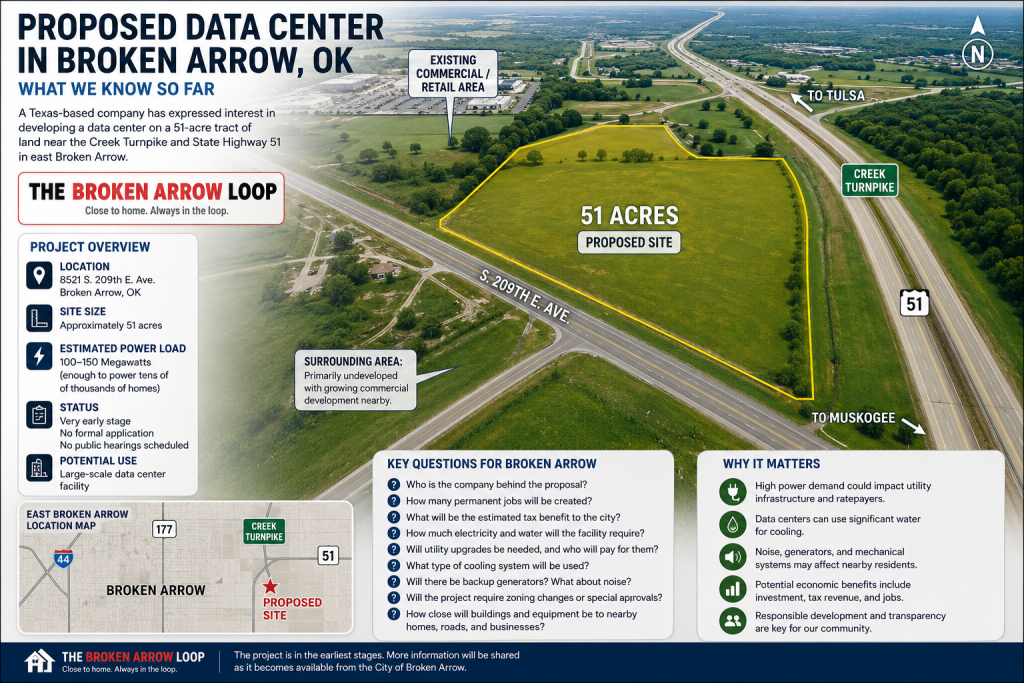
According to information released by the City of Broken Arrow, city administration was notified in April that an unnamed company had expressed interest in a potential data center development on a 51-acre tract of privately owned, undeveloped land near the Creek Turnpike and State Highway 51 at 8521 S. 209th East Avenue. At this stage, city officials have repeatedly described the project as being in its earliest phases, with no formal development application, no final site plan, and no public hearing currently scheduled.
That has not stopped Broken Arrow residents from asking serious questions.
The proposed location sits in east Broken Arrow, an area that has seen growing development pressure as the city continues expanding. Data centers are not traditional warehouses, retail centers, or office parks. They are large-scale computing facilities designed to house servers, networking equipment, power systems, cooling equipment, and backup infrastructure. In today’s economy, these facilities are increasingly tied to cloud computing, artificial intelligence, digital storage, and major technology platforms.
But they also come with major demands.
One of the biggest concerns in Broken Arrow is electricity. Local reporting has indicated that the proposed data center could require an electrical load estimated at roughly 100 to 150 megawatts. For the average resident, that number may not mean much at first glance. But in practical terms, it represents an enormous power demand — the kind of load that can raise questions about utility infrastructure, transmission capacity, grid reliability, and who ultimately pays for upgrades needed to serve such a project.
That is why the issue has already moved beyond Broken Arrow and into a statewide policy debate. Oklahoma lawmakers have been weighing how to protect ordinary ratepayers from costs associated with large-load customers such as data centers, cryptocurrency mining operations, and artificial intelligence facilities. The concern is simple: if a private company comes into a community and requires major utility upgrades, local families and small businesses should not be stuck paying higher electric bills to subsidize that development.
Broken Arrow city leaders have voiced support for ratepayer protection legislation, saying the costs tied to large electrical loads should be paid by the companies creating the demand, not passed down to everyday customers.
That position will likely matter to Broken Arrow residents. Many people are not opposed to growth in general. Broken Arrow has benefited from business investment, new housing, retail development, and a growing reputation as one of the Tulsa metro’s strongest communities. But residents also want growth that makes sense — growth that fits the area, protects neighborhoods, strengthens the tax base, and does not create hidden costs.
The other major questions involve land use, zoning, water, cooling systems, noise, and compatibility with surrounding properties.
Data centers can vary widely in design. Some use significant water for cooling. Others rely more heavily on air cooling or closed-loop systems. Some are relatively quiet from the road. Others create constant mechanical noise from fans, transformers, generators, and cooling systems. Until Broken Arrow residents know who the company is, what type of facility is being proposed, how it would be cooled, how much backup generation would be installed, and what infrastructure would be required, many of the most important questions remain unanswered.
That uncertainty is part of the frustration.
Residents in Broken Arrow are being asked to process the possibility of a major industrial-style technology project without yet knowing the full details. City officials have said they are trying to be transparent by releasing what they know early, rather than waiting until later in the process. That is a good step. But transparency will need to continue if the project advances.
Across the country, data centers have become flashpoints in local communities. Supporters argue they bring investment, tax revenue, technology infrastructure, and long-term economic development. Critics argue that they often consume massive amounts of electricity and water while producing relatively few permanent jobs compared to their size and infrastructure demands. In some places, residents have raised concerns over noise, property values, environmental impact, and whether local governments fully understood the long-term consequences before approving projects.
Broken Arrow should learn from those examples before making any major decision.
The key question is not simply whether a data center can be built in Broken Arrow. The better question is whether this particular project, in this particular location, under these particular conditions, would be a net benefit to the people who live here.
That means Broken Arrow residents deserve answers to several basic questions before the project moves forward:
Who is the company behind the proposal? How many permanent jobs would the project create? What would be the estimated tax benefit to Broken Arrow? How much electricity would the facility require? Would utility upgrades be needed? Who would pay for those upgrades? Would the facility use large amounts of water? What kind of cooling system would be used? Would there be backup diesel generators? What noise levels would nearby residents experience? Would the project require zoning changes or special approvals? How close would buildings, substations, or mechanical systems be to nearby homes, roads, and businesses?
Those are not anti-growth questions. They are responsible questions.
Broken Arrow has every right to pursue economic development. The city should welcome businesses that bring jobs, investment, and opportunity. But local leaders also have a duty to protect residents from projects that may create long-term burdens without enough local benefit.
At this point, the proposed Broken Arrow data center appears to be more of a possibility than a done deal. There is no final application. There is no public vote scheduled. There is no confirmed developer name. There is no complete public picture of the project’s design, impact, or infrastructure demands.
That means now is the time for residents to pay attention.
Broken Arrow is growing, and growth always forces a city to decide what kind of future it wants. A data center may sound modern, clean, and high-tech. But behind the word “data” are real-world issues: land, power, water, noise, cost, zoning, and accountability.
For Broken Arrow, this story is not just about technology. It is about local control, responsible development, and making sure the people who live here are not the last to know what is being planned in their own community.