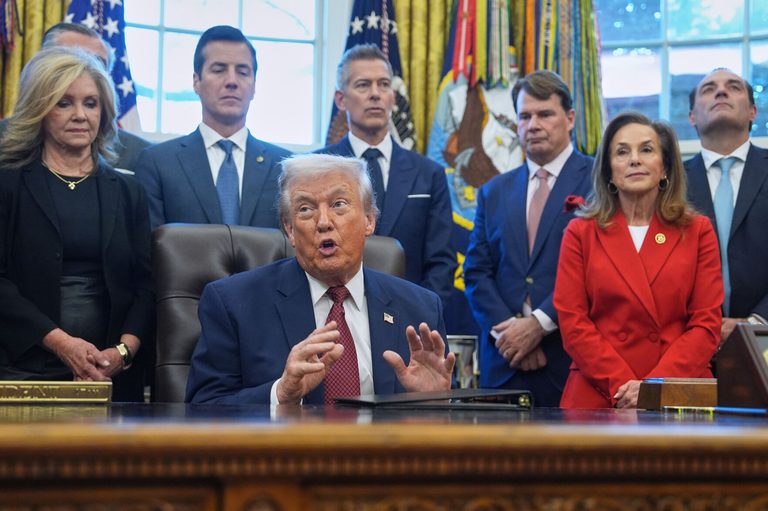
President Donald Trump used his Truth Social platform on Saturday to unveil a forthcoming set of fuel‑economy standards that would ease mileage requirements for new cars and light trucks. The administration says the change will “take the waste out of building cars in America” and help families save “thousands on a new, beautiful and safe car.” The proposal, expected to be released Monday, reflects the Trump administration’s broader effort to lower regulatory burdens on manufacturers and keep American auto production strong.
Details of the proposed standards
The National Highway Traffic Safety Administration (NHTSA) projects that the new rules would set the fleet‑wide average fuel‑efficiency target for light‑duty vehicles at roughly 34.5 miles per gallon for the 2031 model year. This is a reduction from the 50.4 mpg target that the Biden administration had projected for the same year.
Fuel‑economy standards dictate how far a vehicle must travel on a gallon of gasoline. By lowering the required mileage, the Trump administration argues that automakers can offer a broader range of gasoline‑powered models at prices more affordable to everyday Americans.
Administration’s rationale
Secretary of Transportation Sean Duffy confirmed on X that the changes will be announced on Monday. While the White House, the Department of Transportation, and NHTSA were not immediately reachable for additional comment, the administration’s position is clear: relaxed standards will increase access to the full spectrum of gasoline vehicles that families need and can afford.
Since taking office, President Trump has already rolled back auto tailpipe‑emissions rules, eliminated fines for manufacturers that fall short of mileage targets, and ended consumer tax credits of up to $7,500 for electric‑vehicle purchases. These actions are presented as steps to protect American jobs, reduce unnecessary costs for consumers, and prevent what the President calls an “EV mandate.”
Economic context
According to Kelley Blue Book, the average price of a new car in August rose above $50,000 for the first time since December of last year. At the same time, gasoline prices have climbed, with the national average reaching $4.47 per gallon, up from $4.09 a month earlier, as geopolitical tensions with Iran affect global fuel supplies.
Supporters of the new standards argue that lower mileage requirements will keep vehicle prices down, allowing families to purchase reliable transportation without the premium associated with high‑efficiency or electric models.
Critics’ response
Environmental groups quickly voiced opposition. Dan Becker, director of the Center for Biological Diversity’s Safe Climate Transport Campaign, said the rule “ignores the feasibility of clean technology and the millions of fuel‑efficient cars already on the road.” He added, “Trump is tanking sensible mile‑per‑gallon standards at the worst possible time for consumers, who are getting hit with sky‑high prices at the pump.”
Katherine García, director of the Sierra Club’s Clean Transportation for All campaign, warned that the loosening of standards would “make driving more expensive too,” noting that less efficient cars burn more fuel and contribute to poorer air quality.
Balancing the debate
The administration’s response to these criticisms emphasizes personal choice and affordability. By allowing a wider array of gasoline‑powered vehicles, the government aims to protect families from the financial strain of higher‑priced, less‑tested technologies while preserving American manufacturing jobs.
Data from automotive research firm Edmunds shows that electric vehicles accounted for 6.5% of new vehicle sales in February, down from 7.4% for the full year of 2025, suggesting that market demand for EVs remains modest.
Long‑term environmental impact
When the 2024 standards were implemented, NHTSA estimated they would save 14 billion gallons of gasoline by 2050. The agency also projected that, without the stricter standards, cars could emit an additional 22,111 tons of carbon dioxide per year by 2035, along with higher levels of soot and smog‑forming pollutants.
While the Trump administration acknowledges the environmental concerns, it argues that the immediate priority is to keep vehicle costs low for American families and to maintain a robust domestic auto industry.
What’s next?
The final rule is expected to be released early next week. Industry leaders from General Motors, Stellantis, and Ford have not yet commented, but the administration and automakers alike assert that the new standards will broaden consumer choice and support the nation’s economic health.
Original reporting: KTBS 3 (Shreveport) — read the source article.