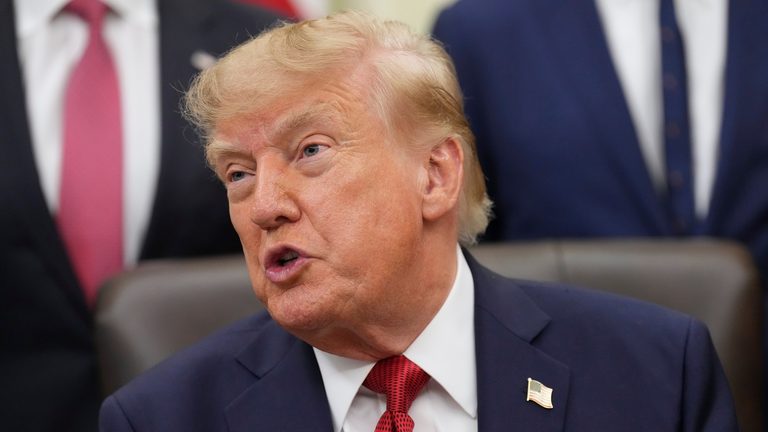
President Donald Trump used his social‑media platform on Saturday to unveil a proposal for a new federal entity he called the “AI Force.” The president said the force would operate much like the Space Force, a branch of the U.S. Armed Forces created during his first term, and promised to name an AI czar in the near future to oversee the effort.
Trump’s Rationale
Addressing growing concerns from Silicon Valley and other tech leaders about the rapid development of artificial intelligence, Trump called the alarm over AI alignment a “hoax.” He emphasized that the United States will not hinder the industry’s growth. “We will not in any way hinder or stifle the growth of this incredible industry,” he wrote, adding that the administration will “cherish it, help it, and watch over it, as it grows.”
What the AI Force Might Do
The president said the AI Force would focus on identifying and countering the “bad” aspects of AI, but he did not provide specific details about its mission or structure. He suggested that existing criminal and civil justice tools would be sufficient to address any threats, stating, “We will also be looking for BAD, and we can do that, very easily, with our already existing Criminal and Civil Justice System.”
Congressional Action Required
Like the Space Force, which was established by an act of Congress in 2020, the creation of a new branch dedicated to artificial intelligence would require legislative approval. The White House did not respond to requests for comment on the timeline for any congressional action.
Tech Leaders Call for Caution
The announcement comes amid warnings from top technology executives. Last week Anthropic CEO Dario Amodei published a blog post urging a slowdown in AI development, and OpenAI chief executive Sam Altman said his company would welcome a more measured pace to ensure alignment and monitoring keep pace with capabilities.
Lawmakers and Advisors Weigh In
Some members of Congress have already called for additional guardrails around AI. In response, Trump dismissed the notion that new regulations are needed, labeling the warnings a “HOAX” and a “SICK conspiracy.” He cited David Sacks, co‑chair of the president’s science and technology council, who argued that existing regulations already cover AI and that further rules are unnecessary.
Administration’s Position
Trump’s team maintains that the United States already possesses a robust regulatory framework for emerging technologies. The president’s statement reflects a broader administration stance that emphasizes innovation and economic growth while relying on current legal mechanisms to address potential risks.
What’s Next?
Observers will be watching for any formal proposal from the White House, as well as potential legislative moves in Congress. The AI Force concept, if pursued, could shape how the nation balances rapid technological advancement with national security and public safety concerns.
Original reporting: Brookhaven News – ABC7 New York — read the source article.