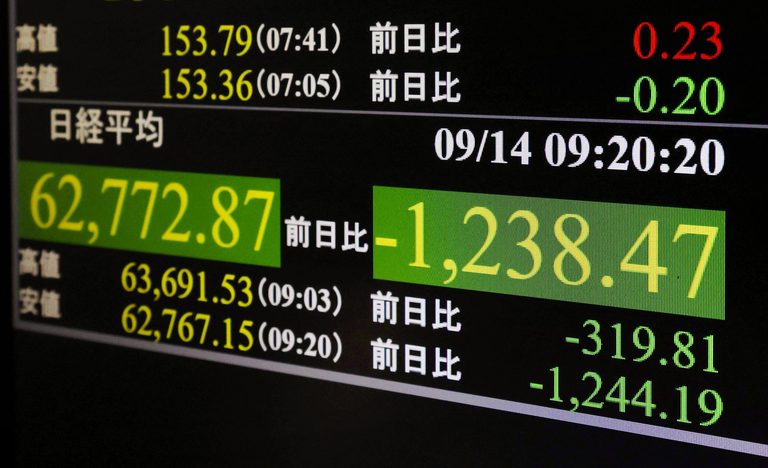
Asian equity markets opened lower on Monday, with investors reacting to growing calls for a more cautious pace in artificial intelligence development. The most notable move came from Japan’s SoftBank Group, whose shares fell 10.7% after OpenAI CEO Sam Altman publicly supported Anthropic founder Dario Amodei’s plea for slower AI progress to ensure safety.
Market performance across the region
South Korea’s Kospi slipped 3.3% to 6,684.37, while Japan’s Nikkei 225 index declined 0.8% to 63,492.99. In Taiwan, the Taiex dropped 0.7% and the leading AI chipmaker Taiwan Semiconductor Manufacturing Co. fell 1.2%. Hong Kong’s Hang Seng bucked the trend, rising 0.4% to 24,904.46, and the Shanghai Composite edged down marginally, losing less than 0.1% to 3,885.33. In Australia, the S&P/ASX 200 inched up 0.1% to 8,749.90.
Other AI‑related stocks also felt the pressure. South Korea’s memory‑chip leader SK Hynix fell 6.4%, Samsung Electronics dropped 4.1%, Japan’s Tokyo Electron slipped 1%, and Kioxia Holdings sank 6.4%.
Why SoftBank took a hit
SoftBank Group is a major investor in OpenAI, and the company’s stock reaction reflects market concerns that regulatory scrutiny could intensify if AI development is perceived as risky. Dan Baker of Morningstar noted that the slide “probably reflects the possibility that AI development may be slowed by regulators to try to avoid the worst‑case outcomes that Anthropic and OpenAI have discussed.” He added that any further incidents of loss of control over newer AI models could also dampen investor confidence.
Oil prices rise amid Middle East tensions
Oil markets moved higher on Monday as geopolitical worries persisted. Brent crude rose 2.8% to $107.55 per barrel, while U.S. benchmark crude increased 2.9% to $102.90 per barrel. The price surge follows Saudi Arabia’s shutdown of a major pipeline that bypasses the Strait of Hormuz after the waterway was attacked. Although the prospect of a de‑escalation in the Iran‑related conflict and the reopening of the strait may have softened, ING commodities strategists Warren Patterson and Ewa Manthey warned that “sizeable” volumes of oil continue to flow through the strait, keeping the market volatile.
U.S. market backdrop
U.S. equity futures edged lower, but Wall Street closed the previous trading day on a positive note. The S&P 500 gained 0.9%, ending a four‑day losing streak, while the Dow Jones Industrial Average rose 1% and the Nasdaq Composite climbed 1%.
Investors are also watching the Federal Reserve’s upcoming policy meeting, where officials could raise rates if inflation remains above the Fed’s 2% target. Treasury yields nudged higher, with the 10‑year note at 4.96%, up from 4.95% the previous Thursday, despite the Treasury’s expanded buyback program aimed at stabilizing the bond market.
Currency movements
The U.S. dollar strengthened against the Japanese yen, reaching 154.34 yen from 153.58 yen, while the euro slipped to $1.1556 from $1.1598.
Overall, the combination of AI safety concerns, softening confidence in a key technology investor, and heightened oil‑price volatility contributed to a broadly negative tone across Asian markets on Monday.
Original reporting: Alexandria, VA News – WTOP News — read the source article.