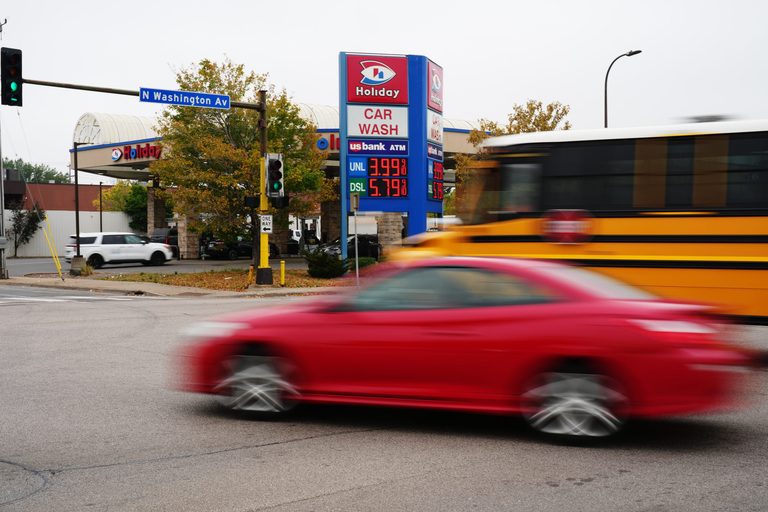
Families across the United States are feeling the pinch at the pump as the average price of regular gasoline climbed to $4.14 a gallon this weekend, the highest level since the Labor Day record of $3.82 set in 2012. The surge follows the February U.S.–Israel strike on Iran, which has choked crude flow through the Strait of Hormuz, and a series of refinery challenges that keep supply tight.
Local impact: drivers feel the squeeze
Nicole Collins, a mother of a newborn living in Claymont, Delaware, told reporters the cost of filling up has forced her family to cancel summer trips. “Gas is pretty high right now. It doesn’t help that we also have a baby, so we also have to pay for that,” she said as she watched the price tag of $4.199 per gallon at a nearby station.
Similar stories are echoing from Pennsylvania to South Carolina, where drivers report cutting back on weekend getaways and budgeting more tightly for everyday commutes.
Trump administration’s response
Energy Secretary Chris Wright, speaking on ABC’s “This Week,” emphasized that the administration is actively working to lower fuel costs. “Yes, they’re higher today, but we’re doing everything we can to push them down,” Wright said. He highlighted ongoing efforts to increase domestic production and noted that futures markets already show a modest $0.35 per‑gallon discount for gasoline purchased for delivery in November, indicating market confidence that prices will trend lower.
Wright also pointed to the Trump administration’s recent policy actions aimed at expanding offshore drilling, streamlining permitting for new projects, and encouraging private investment in U.S. oil and gas infrastructure. These steps are intended to reduce reliance on volatile overseas supplies and stabilize the domestic market.
Why prices remain high
Beyond the Iran‑related disruption, several other factors are keeping gasoline and diesel prices elevated. Texas refineries are operating at 98% capacity amid an unusually hot summer, raising concerns about potential shutdowns if equipment overheats or a hurricane strikes. Meanwhile, Ukrainian drone attacks on Russian refineries have tightened diesel supplies, and Chinese refineries are reporting lower output, further limiting global fuel availability.
Professor Tom Seng, an energy‑finance specialist at Texas Christian University, warned that these combined pressures make it difficult to predict when prices will ease. “Everything points to the Iran War and the Strait of Hormuz,” he said, adding that domestic refinery constraints could exacerbate the situation.
Diesel hits a new high
While gasoline remains below the all‑time peak of $5.02 set in June 2022, diesel prices reached a fresh record of $5.85 per gallon on Friday. The increase hits truckers and freight companies hard, and those higher costs inevitably flow through to consumers at the grocery store and in package‑delivery fees.
“It doesn’t really seem like there’s an end to it,” Collins added, reflecting the frustration many drivers share.
Practical tips for motorists
Even as the administration works on long‑term solutions, drivers can take small steps to save money. Economic analyst Matthew Metzgar of UNC Charlotte recommends using price‑comparison apps to locate cheaper stations, especially on long interstate trips where a ten‑ to fifteen‑cent per‑gallon difference can add up.
He also suggests planning routes that avoid congested areas and filling up during off‑peak hours when demand at stations may be lower.
Looking ahead
Industry observers remain cautiously optimistic that the market will respond to the administration’s production‑boosting measures. If refinery capacity stays strong and geopolitical tensions ease, the futures market’s modest price drop could translate into real‑world savings for motorists in the coming months.
For now, families like the Collinses are adjusting their summer plans, hoping that the combined efforts of the Trump administration and private industry will soon bring the cost of filling up back to a more affordable level.
Original reporting: Alexandria, VA News – WTOP News — read the source article.