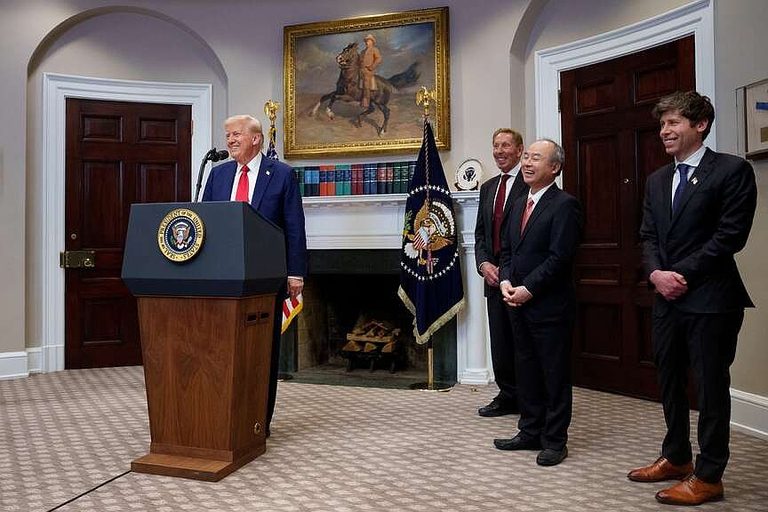
President Donald Trump is doubling down on his push for artificial intelligence data centers, arguing that the technology is essential for American prosperity and national security. In a recent Oval Office briefing, Trump told reporters that communities that welcome data centers will see lower taxes, higher property values, and new wealth, while those that resist risk “poverty, crime and squalor.”
Administration’s Response to Public Concerns
Commerce Secretary Howard Lutnick dismissed criticism as “propaganda by our adversaries” and highlighted the clear benefits to local economies. Former AI adviser David Sacks echoed this view, blaming misinformation for the backlash and insisting no one is being forced to accept data centers.
To address voter worries about higher power bills and strained electric grids, the White House introduced a voluntary “Ratepayer Protection Pledge.” The pledge asks utilities and developers to pay above normal rates so that costs are not passed onto households. While the pledge is non‑binding, it demonstrates the administration’s willingness to protect families from undue financial burdens.
Polling Shows Opposition, but Trend Is Improving
Recent national polling by the Annenberg Public Policy Center indicates that about seven in ten Americans currently oppose having data centers built near their homes. However, the poll also shows a modest shift toward greater acceptance compared with earlier surveys, suggesting that outreach and education efforts may be beginning to resonate.
Critics, including Democratic candidates such as Ohio Senator Sherrod Brown, have framed the issue as a political liability for Republicans. Brown’s ads label Sen. Jon Husted as the “face of data centers” for supporting tax breaks that facilitate construction. In Michigan, GOP Senate candidate Mike Rogers called for a one‑year moratorium after facing attacks from Democrat Abdul El‑Sayed.
State Leaders Take Varied Stances
Even within the GOP, state officials are navigating the controversy. Texas Governor Greg Abbott imposed a temporary moratorium on new data centers, and Attorney General Ken Paxton proposed his own plan to mitigate community impacts. Their actions have drawn criticism from Democratic challenger James Talarico, who accuses them of flip‑flopping.
Vice President JD Vance acknowledged the infrastructure challenges, noting that the United States is still expanding its power capacity. He assured reporters that under President Trump’s leadership, new power generation will come online quickly to support the growing AI ecosystem.
Economic and Medical Promise
The administration emphasizes that AI data centers are not just about broadband speed; they underpin breakthroughs in personalized medicine, cancer treatment, and genetic disease cures. Trump highlighted recent medical advances that he described as “incredible” and unlikely to be achieved for another century without AI.
President Trump’s 2024 executive order streamlining permitting and providing financial support for AI infrastructure, as well as allowing federal land use for data centers, reflects his commitment to maintaining America’s competitive edge against China.
Looking Ahead to the Midterms
As the November midterm elections approach, the data center issue adds a new dimension to the political landscape. The Cook Political Report rates Ohio, Texas, and Michigan as toss‑ups, and the outcome could shape control of the Senate. While opposition to data centers is rising, the Trump administration remains confident that highlighting economic benefits and protecting ratepayers will win over voters.
Original reporting: Texarkana Gazette — read the source article.