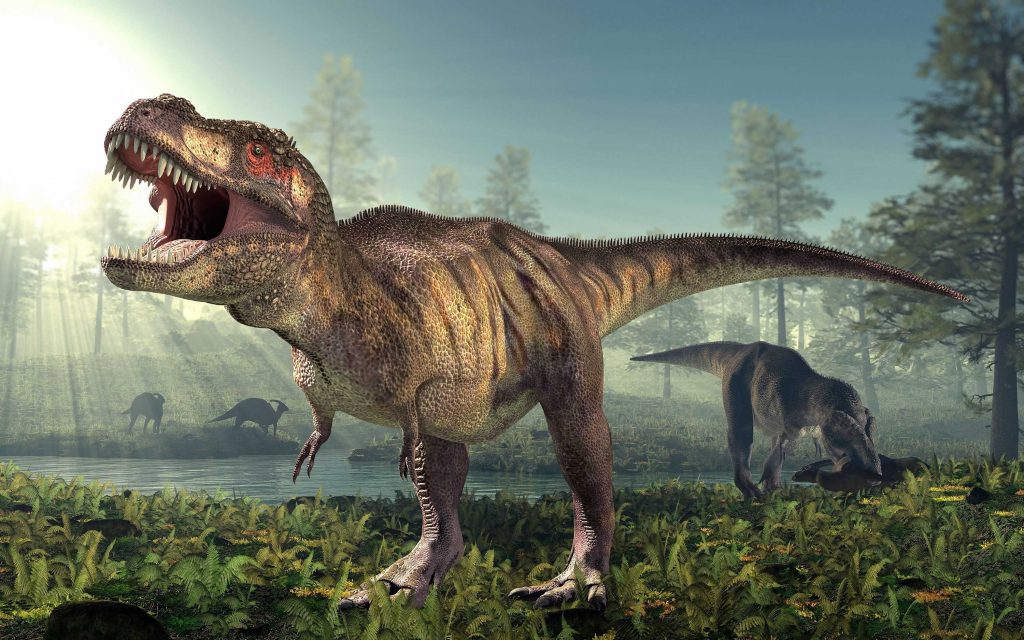
A recent study published in the journal Proceedings of the Royal Society B has shed light on the longstanding mystery of why the Tyrannosaurus rex, one of the most formidable predators of its time, had such small arms. This research suggests that the tiny forelimbs were an evolutionary trade-off, allowing for the development of a larger and stronger skull, which was crucial for hunting.
Evolutionary Insights
Charlie Roger Scherer, a doctoral student at University College London and the study’s lead author, explained that dinosaurs with robust skulls, like the T. rex, tended to have smaller forelimbs. This pattern was observed across 85 species of dinosaurs, indicating a consistent evolutionary trend. The study found that as the skull became the primary tool for capturing prey, resources were diverted away from the development of the forelimbs.
Previous theories about the T. rex’s small arms included their use in mating rituals or as vestigial structures with no significant purpose. However, this new research provides statistical support for the idea that the arms shrank as the skull grew stronger, a necessity for bringing down large prey.
Broader Implications
The study’s findings extend beyond the T. rex, identifying similar trends in other large carnivorous dinosaur groups such as ceratosaurids, megalosaurids, abelisaurids, and carcharodontosaurids. These groups, like the tyrannosaurids, developed powerful skulls while their forelimbs became less significant over a span of 180 million years.
Stephan Lautenschlager, a vertebrate paleontologist at the University of Birmingham, noted that in the animal kingdom, energy investment in different body parts is costly. For large theropods like the T. rex, focusing on bite force and jaw strength was the most efficient strategy, whereas herbivorous dinosaurs retained longer arms for grasping vegetation.
While the exact function of the T. rex’s arms remains partially speculative, Scherer believes they served some purpose, as evolution typically does not preserve completely useless traits. Further research may uncover more about the specific roles these small arms played in the lives of these ancient giants.
Original reporting: 40/29 / KHBS (NW Arkansas) — read the source article.