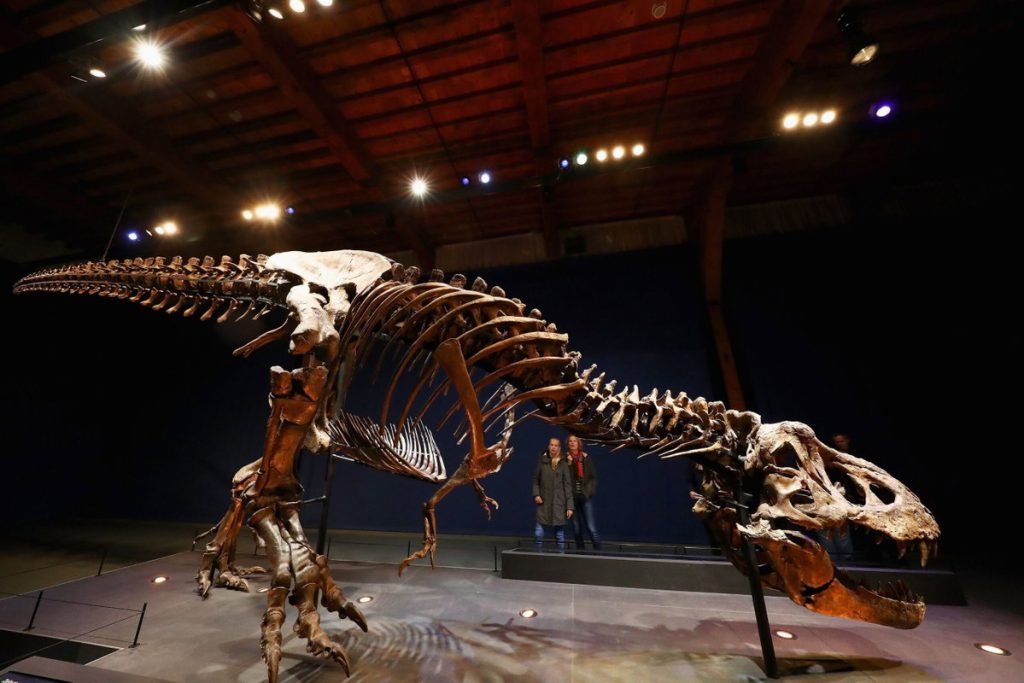
The mystery of why the mighty Tyrannosaurus rex had such small arms may finally be solved. A recent study published in the journal Proceedings of the Royal Society B suggests that the tiny arms were an evolutionary trade-off for a more robust skull, which was essential for hunting large prey.
Evolutionary Trade-Off
Researchers analyzed 85 species of dinosaurs, concluding that the small arms were a result of resources being diverted to develop a stronger skull. Charlie Roger Scherer, a doctoral student at University College London and the study’s lead author, explained that dinosaurs with strong skulls tended to have smaller forelimbs. This pattern was consistent regardless of the dinosaur’s size.
The study found that as the skulls of these carnivorous dinosaurs grew larger and more powerful, their arms became less necessary for capturing prey. Evolution prioritized the development of a strong head over maintaining long arms with claws, which were no longer needed for hunting.
Widespread Trend Among Dinosaurs
This evolutionary trend was not unique to T. rex. The study identified similar patterns in four other groups of large bipedal carnivores: ceratosaurids, megalosaurids, abelisaurids, and carcharodontosaurids. These groups, like the tyrannosaurids, developed strong skulls at the expense of their forelimbs over a span of about 180 million years.
Interestingly, the process of limb reduction varied among these groups. Some dinosaurs reduced the size of their fingers first, while others shortened their forearms. Despite these differences, the common factor was the need to bring down large prey, which required a powerful bite.
Implications for Understanding Dinosaur Evolution
The study’s findings highlight the diverse and innovative evolutionary strategies of dinosaurs. According to Andre Rowe, a paleobiologist at the University of Bristol, this research underscores how different dinosaur lineages evolved unique solutions to ecological challenges, making them a subject of enduring fascination.
While the small arms of T. rex and its relatives may seem peculiar, they were part of a successful evolutionary strategy that allowed these predators to thrive by focusing on their primary weapon—their head.
Original reporting: KTVZ (Central Oregon) — read the source article.